A Swiss chair-parts supplier sent us one physical sample: a wooden chair base with four dowel legs, a black wire cross-brace, metal fittings, screws and floor glides. He wanted a matching base made in China, with the same look, the same dimensions and the same structure, for a first order of 150 sets.
This case study covers how we sourced it: why the original walnut and oak specification did not fit a 150-set budget, how a beech alternative kept the match where it mattered, how the quotation was structured, and how the client approved the sample from photos and video before it shipped.
Starting point
One physical sample
First order
150 sets
Result
Look, size and structure matched; material changed to beech

The Client: A Chair-Parts Supplier Needing Matching Replacement Chair Legs
The client is a chair-parts supplier in Switzerland. He sells components rather than finished chairs, and his purchase volumes per order are not large.
He needed replacement chair legs and bases that would fit his existing product line. That meant the new base had to match what he already sold: material, dimensions and color. A base that looked close but did not fit his chairs would be worthless to him.
Timeline: From Inquiry to Physical Sample
The project did not start fast, and that is normal for a busy buyer.
- May 18: We received the inquiry. The client was busy and did not give a clear instruction straight away. We stayed in touch and kept him updated without pushing.
- June 22: The client decided the clearest brief was the product itself and shipped us a physical sample to quote and sample from.
- July 3: We received the sample and started quoting.
- July 7: After comparing factories, we sent the first quotation.
A physical sample removes most of the guesswork that drawings and photos leave behind: wood tone, leg taper, hole positions, fittings and how the parts join. For a dowel leg chair base that must fit an existing chair, it is the best brief a buyer can send.

Finding Factories: Online Shortlist and a Visit in Guangdong
We started online. Several factories already make this style of chair base or can customize it, but most did not stock walnut or oak. They worked mainly in beech and other more affordable woods.
To test the walnut and oak route properly, we asked a sourcing partner in Guangdong to take the sample to factories in person, so they could see and handle it rather than quote from photos.
Visiting factories with a sample is useful, but it is not a guarantee of a better result. In this project, the factory that won the order was one we had found online at the start. Our guide on how to verify a Chinese supplier explains how we check factories before a client pays for anything. For broader furniture projects, see our China furniture sourcing agent service.
The Material Decision: Walnut and Oak vs Beech
The client’s original request was walnut or oak, matched one to one. After comparing factories, the walnut and oak route had a high sample cost and a high minimum order. With a first order of 150 sets, the client could not justify that budget.
We did not simply tell him no. We went back to the online factory that worked in beech, which had a lower minimum order and a lower sample fee, and laid out both options side by side, including the real differences between the woods. The client chose the beech route. The result matches the look, dimensions and structure of his sample, with beech chair legs instead of walnut or oak. European beech is a hard, strong hardwood widely used for furniture, but it looks different from walnut and needs its own handling.
Read how we weighed walnut against beech, and what the trade-off really costs →
How the Quotation Was Structured
We do not publish this client’s prices, but the structure of the quotation is worth showing because it explains where the money goes on a part like this:
- Two volume tiers. The factory quoted a unit price at two different order volumes. The higher volume brought a lower unit price.
- A mold fee for the metal parts. Some hardware needs its own tooling. At the higher volume tier, the factory offered to cover half of the mold fee.
- A separate wooden sample fee of a few hundred US dollars.
- Hardware sampled after tooling. Metal parts that need new molds can only be sampled once those molds are made, so the client knew upfront which parts could be sampled first.
Splitting the quote this way lets a buyer see which costs are one-off (molds, samples) and which repeat with every order (unit price), and how both change with volume.
Sampling and Approval of the Wooden Chair Base
Once the client paid the sample fee, we sent his sample to the beech factory. During sampling, we kept confirming details with the client so the result would look as close as possible to his original to the naked eye.
As soon as the factory finished, we sent the client side-by-side comparison photos and a detail video of the new sample next to his original.
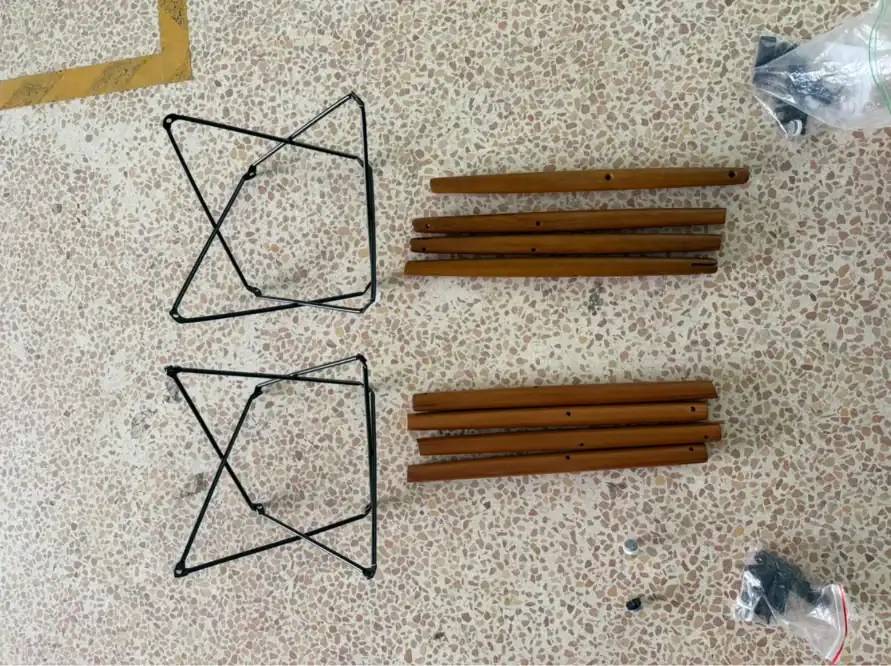
After watching the video and checking the detail shots, the client replied: “Perfect. Pls ship.” That approved shipping the sample to him. It was a sample approval, not a bulk order confirmation.
We then shipped the sample to the client. Our approach to sample approval is set out in more detail in sample management in China sourcing and the custom furniture approval checklist.
Where the Project Stands
The client has approved the sample’s overall workmanship and appearance. A few small details are being fine-tuned, and we are now discussing the bulk order with him.
What made this project work was not finding the one factory that could do walnut cheaply. It was being honest about what a 150-set budget could buy, then matching the parts of the sample that mattered most to the client’s business: how the base looks, how it fits and how it is built.
Have a sample you need made in China?
Send us photos of your sample, your target quantity and the details that must match. We will tell you which factories can make it, where the cost and MOQ risks are, and which material options fit your budget.