Sourcing gift bags from China gets complicated fast when a single order contains 21 different styles, each style needs only 500 to 1,000 pieces, and everything has to land in Mexico before Christmas. Total quantity: somewhere between 15,000 and 20,000 pieces. On paper, that sounds like a decent-sized order. In practice, the quantity was never the problem.
The problem was that no single factory in China makes 21 different styles of gift packaging. And almost none of them wants to produce 500 pieces of anything.
A Buyer Who Orders Like Twenty Clients at Once
The client runs a gift packaging business in Mexico and also works as a buying agent for local companies. She collects requirements from her own end customers, then sends one combined order to China. So her orders never look like standard wholesale. Many styles, small quantity per style, no fixed SKUs, and demand that spikes hard before holidays. Christmas is her busiest window, and her deadlines don’t move.
Why 21 Small-Batch Styles Broke the Normal Sourcing Process
Three things made this order difficult.
First, the MOQ mismatch. She had seen gift bags and boxes she liked at the Canton Fair and passed us the supplier’s business card to make contact. We got the catalog and sent it over. Her reaction was quick: prices too high, minimum order quantities too high. Fair suppliers are set up for buyers ordering thousands of pieces per design. She needed 500 to 1,000.
Second, the styles were scattered. Gift packaging looks like one category from the buying side, but on the factory side it’s several different industries. Paper bag factories don’t make rigid boxes. Non-woven bag lines don’t run jute totes. Her 21 styles were spread across factory types with no unified catalog anywhere.
Third, time. Her end customers pick styles on short notice, and the Christmas deadline meant she needed stock wherever stock existed. There was no room in the calendar for long production runs.

A sample of the 21 styles, sorted for inspection.
From a Canton Fair Business Card to a Split Sourcing Plan
After the fair supplier fell through on price, we moved to 1688 to compare factory quotes directly. The platform had the design range and the flexibility. What it didn’t have was speed. With 21 styles spread across different factories, building a clean comparison list was eating days the client didn’t have. As a 1688 buying agent, we do this kind of screening constantly — but this order was moving faster than the screening could.
So we brought in Yiwu market suppliers, who had two things 1688 factories couldn’t offer: ready catalogs and physical stock. We sent their catalogs to the client and her end customers started selecting. Then the next problem surfaced. Many of the styles they chose were catalog items, not stock items. Producing them fresh meant MOQs far above 500 to 1,000 pieces per style. A market supplier’s catalog is not a stock list. It’s closer to a menu of what they can make. Buyers get caught by this constantly.

Catalog and quote files sent for the client’s style selection.
At that point we stopped trying to solve the order through one channel and split it. Styles that genuinely existed as Yiwu stock stayed with the market suppliers. Everything else went back to 1688, where we searched for the same designs or close equivalents from factories willing to take small runs. Neither channel could carry the whole order. Together they could.
Spanish Import Labels, Applied Piece by Piece
Customization was minimal on this order. The products are the packaging, so there was no logo work — plain brown cartons were enough for outer packing. What did need handling was Mexican import labeling. Each piece received a Spanish-language label carrying the product description, composition, importer details and country of origin. We applied these at our warehouse after sorting, as part of the packaging and labeling work before loading. It’s slow, repetitive work across 15,000+ pieces, and it’s exactly the kind of task that goes wrong when goods from seven different suppliers aren’t properly separated first.

A finished gift bag with its packaging label attached.
Batch-by-Batch Checks Across 21 Styles
The client had visited our warehouse in person on an earlier trip, so she already trusted the operation — which mattered, because this timeline had no room for long photo-approval loops. As goods arrived from different suppliers on different days, we sampled each batch on arrival, sorted everything by style, then ran the labeling.
No major quality problems came up. The real risk in an order like this usually isn’t one bad factory — it’s mixing. Twenty-one styles, some visually similar, arriving on different days, is exactly how wrong-carton problems happen. Sorting discipline mattered more here than inspection drama.

Batch checks and sorting in progress.
Why We Told the Client to Use Her Own Mexican Agent
Shipping was the decision point of this project. Mexican customs clearance is complicated, and our forwarder resources on China-to-Mexico lanes were limited. If we shipped direct from China, clearance timing would have been the one variable nobody could control — on the one order where timing was everything.
So we recommended something a sourcing agent doesn’t usually recommend: don’t give us the freight. Her local Mexican agent had real experience and real channels on the destination side. We proposed working EXW — we handle everything in China, including consolidation, sorting, labeling and clearance document support, and her agent takes over freight and Mexican clearance. She hesitated at first. Splitting the job between two agents sounds like more coordination, not less. After we walked her through the reasoning, she agreed.
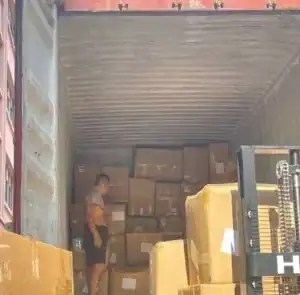
After sorting and labeling, cartons went into the container against the packing list.
Landed Before Christmas. The Orders Kept Coming.
Everything shipped on schedule. Clearance in Mexico went through without holds. The client received the full order before Christmas — no delays, no stuck containers. She has continued reordering since, and keeps handing us her new gift packaging orders as they come in from her end customers.

Two containers loaded and ready for the Christmas deadline.
The Takeaway for Small-Batch, Multi-Style Buyers
If your order looks like this one — many styles, small runs, a hard seasonal deadline — stop searching for the one supplier who can do everything. That supplier doesn’t exist. Decide which parts of the order need existing stock and which parts can flex on design, then source each group through the channel built for it. And be honest about the last mile: sometimes the fastest route to your door runs through your own local network, not your sourcing agent’s.
What This Case Study Shows About Sourcing Gift Bags From China
Gift packaging behaves differently from most product categories. A buyer sees one order; the factory side sees five production processes. That fragmentation is why single-channel sourcing plans keep failing on multi-style, small-batch orders. Splitting between Yiwu market stock and 1688 factory runs isn’t a workaround — for orders like this, it’s the correct structure. We used similar consolidation logic on the full container we assembled from Yiwu market for a US buyer, and it holds up across categories.
The second thing worth taking from this case is the stock illusion. Market suppliers show catalogs; buyers read catalogs as inventory. They’re not the same thing. For holiday orders, the difference decides whether your goods exist in a warehouse today or exist as a production plan with a 3,000-piece MOQ attached. Confirm physical stock before your end customers fall in love with a design.
And the shipping decision is the part most sourcing companies won’t say out loud. Plenty of China-side forwarders will quote a Mexico door-to-door rate. Far fewer can control what happens after the vessel arrives. When the clearance risk sits on the destination side, the destination side should own it — even if that means the sourcing agent takes a smaller scope. That recommendation cost us the freight margin on this order. It’s also a big part of why the client still sends us every new order.
FAQ: Sourcing Small-Batch, Multi-Style Products From China
Is gift bag sourcing from China realistic for orders with 20+ different styles?
Yes, but it usually means working across more than one supplier channel — in-stock catalog suppliers for speed, and flexible-MOQ suppliers for styles that need production. Trying to force everything through a single supplier often costs you either speed or minimum order flexibility.
What’s the difference between sourcing through Yiwu market and 1688 for small orders?
Yiwu market suppliers typically offer catalogs and ready stock, which is faster but limited to what’s already made. 1688 sourcing is more flexible on MOQ and customization but takes longer to organize, especially across many scattered styles.
How does EXW shipping work for orders going to Mexico?
Under EXW, the supplier’s side handles domestic preparation — packing, labeling, and documentation — and the buyer’s own freight or customs agent takes over from the origin point. For Mexico specifically, this often means the buyer’s local licensed customs broker manages clearance.
Why does Mexican customs clearance take longer than expected sometimes?
Most commercial imports require a licensed customs broker by law, and documentation errors can cause real delays. Working with an experienced local agent on the Mexican side, rather than relying entirely on an unfamiliar direct freight route, tends to keep clearance timing more predictable.
Can small-batch orders still get factory-direct pricing from China?
It depends on the product and channel — flexible 1688 suppliers can sometimes work with smaller runs at a fair price, especially for simpler products like gift bags, though pricing per unit is usually higher than a standard bulk order.
If you’re managing multi-style, small-batch orders and need a China sourcing agent who can split sourcing across channels without missing your deadline, you can start with a free sourcing trial or contact us directly.