Private label furniture packaging requirements should be settled before production, not during the final week before shipment.
That sounds obvious. In practice, packaging is often treated as a finishing task. The product specification receives attention first. The logo file, carton marks, care label and instruction sheet arrive later from different people. By then, the factory has already ordered cartons or printed the first batch.
Furniture makes this harder because one item may have exposed finishes, loose hardware, several cartons, assembly instructions and destination-specific labels. A packaging mistake can leave a good product difficult to identify, assemble or sell.

This checklist explains how an importer can control the packaging and labeling work without turning it into a separate product-development project.
Private label furniture packaging requirements: what the system must achieve
Packaging has several jobs. It protects the furniture, identifies every component, carries the buyer’s brand and gives the warehouse or end customer enough information to handle the item correctly.
These jobs should be written separately. A branded carton can still offer poor protection. A strong carton can still carry the wrong model number. A correct product label can still be placed where the customer will never see it.
Start by defining the result for each layer:
- Product protection: surfaces, corners, glass, metal parts and upholstery arrive without avoidable damage.
- Product identification: the item, model, colour, carton number and quantity can be matched to the purchase order and packing list.
- Brand presentation: approved logos, colours and wording appear consistently.
- Handling: warehouse teams can see orientation, weight or fragile-content warnings where relevant.
- Customer use: assembly, care and safety information is supplied for the actual product.
Create one packaging requirements file
The private label furniture packaging requirements file should be the single working reference for the buyer, supplier and inspector.
Do not manage packaging through scattered email messages. Use one controlled file that shows what appears on the product, inner packaging, master carton and printed inserts.
The file should include the latest approved artwork, dimensions, materials, print colours, placement and revision date. If the buyer uses several furniture factories, apply the same document structure to each one.
Record product and order references
List the buyer’s SKU, supplier model, purchase-order reference, finish or colour, quantity per carton and number of cartons per set. The supplier’s internal item name is not enough. It may not match the buyer’s inventory system.
For sets packed in several cartons, make the relationship visible: carton 1 of 3, carton 2 of 3 and carton 3 of 3. A warehouse should not need to open cartons to discover which pieces belong together.
Separate fixed brand assets from variable order data
The logo, brand colours and standard company wording may stay fixed. Model number, destination, purchase order and carton quantity may change with every order.
Keeping fixed and variable information separate reduces artwork mistakes. It also makes the approval process faster because the buyer can see exactly which fields changed.
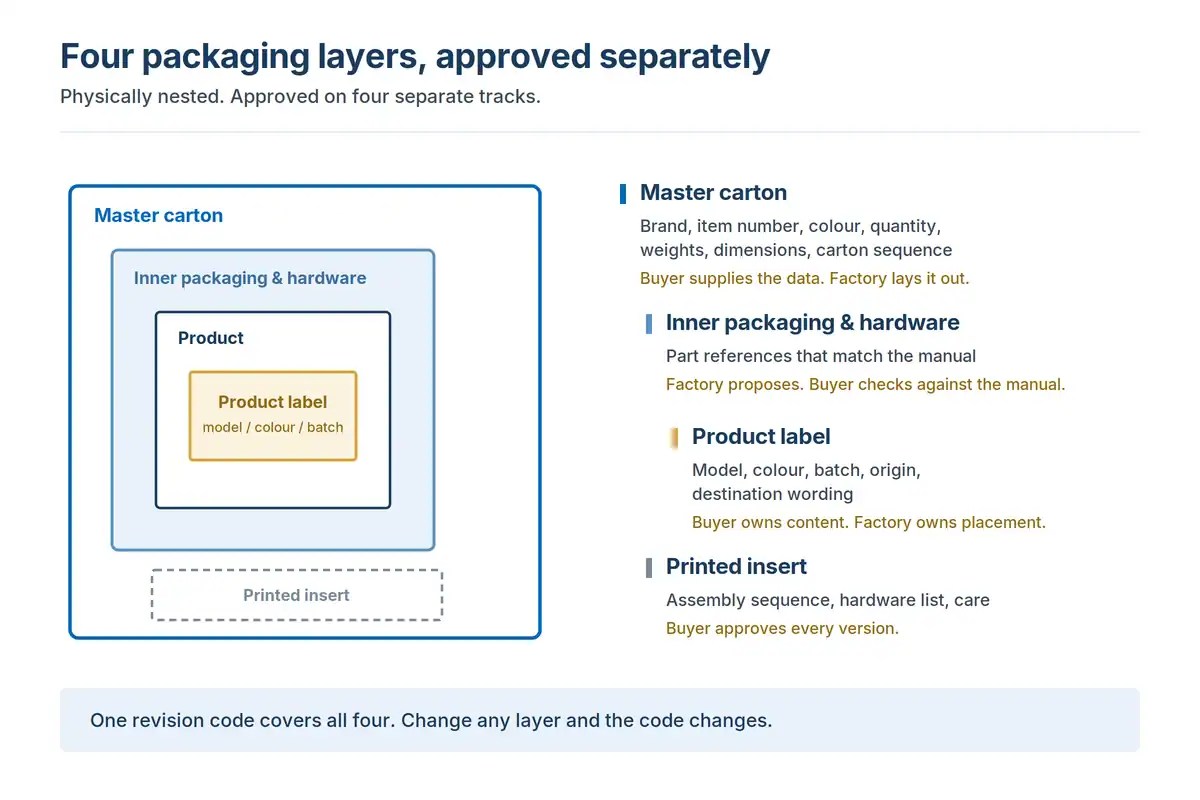
Control product labels, carton marks and printed inserts separately
These items are connected, but they are not interchangeable. Each one needs its own approval.
Product label
The product label normally identifies the item after the carton has been removed. Confirm the model or SKU, colour or finish, batch reference where used, country-of-origin wording where required and any destination-specific information supplied by the buyer. For panel furniture entering the United States, the product label is also a compliance record. Finished goods containing hardwood plywood, MDF or particleboard fall under the EPA formaldehyde emission standards for composite wood products, which require the finished good or its box to be labeled as TSCA Title VI compliant.
Confirm with the buyer whether that wording is already on the factory’s label or has to be added to the artwork. Some categories carry a fixed label the buyer cannot redesign. A chest or dresser sold in the United States is subject to 16 CFR Part 1261, which adopts ASTM F2057-23 and sets the content and placement of the tip-over warning. Brand styling cannot override that wording.
Confirm the label material and attachment method. A paper sticker placed on a dusty timber surface may fall off. A label fixed to visible upholstery may leave residue. The correct location depends on the product and how the buyer expects it to be used.
Inner packaging and hardware identification
Hardware bags should be linked to the assembly instructions and furniture model. If two similar tables use different bolt lengths, a generic unmarked bag creates a preventable assembly problem.
Use clear part references. If the manual calls a component “Bolt B,” the bag should not call it “Screw 2.” Small inconsistencies become expensive when hundreds of customers need support.
Master carton marks
Carton marks should match the final packing list. Typical fields include brand, item number, description, colour, quantity, gross and net weight, carton dimensions, carton sequence and handling marks where relevant. Where handling marks are used, take them from ISO 780 instead of redrawing a symbol in the artwork file. A redrawn “this way up” arrow is the kind of small change that survives approval and then fails in a warehouse that reads the standard symbol.
Do not copy weights or dimensions from an early quotation. Use the finished packing method. Foam thickness, extra hardware and reinforced cartons can change the final data.
Assembly and care instructions
Instructions should show the actual product version. Check the number of parts, hardware quantities, tool requirements, assembly sequence and contact information approved by the buyer.
Care wording must match the material and finish. Avoid generic claims that have not been confirmed by the material supplier or buyer. Destination-market legal and compliance wording should be confirmed with the buyer’s qualified adviser or customs broker.
Approve artwork before the factory prints a batch
A digital file is not the final packaging. The safest process has three approval points. It runs in parallel with the product side of the approval, not after it — the same discipline used in a drawing and finish approval checklist, applied to the printed layer instead of the furniture.

First: approve the content
Check spelling, SKU references, dimensions, barcodes, symbols and language. Test every barcode from the supplied artwork rather than assuming the number printed below it matches the encoded data. Where the buyer uses GS1 identifiers, verify the format against the official GS1 barcode guidance.
Second: approve the layout
Review the dieline or placement drawing. Confirm which panel is the front, where tape or straps will cover information, and whether important text remains readable after the carton is closed.
Third: approve a physical reference
For a new packaging setup, request a physical sample or production-standard mock-up. Check print colour, legibility, label adhesion, carton fit and the way protective materials contact the furniture.
Keep the approved reference with a revision code, and store it alongside the approved production reference for the product itself. “Use the same packaging as last time” is not a reliable instruction unless both sides can identify the same approved version.
Furniture packaging details buyers commonly miss
Structure, joint design, packed volume and the choice between assembled and knock-down are covered in designing furniture for export shipping. The points below are the ones that go wrong specifically because a label, a hardware bag or a carton sequence was not controlled.
Finish-to-packaging contact
Protective materials can mark painted, plated or polished surfaces. Confirm whether foam, film, tape or printed paper touches the finish directly. The risk may only appear after the product has stayed packed for several weeks.
Corner and edge protection
Furniture damage often starts at edges, legs and corners. Check whether protectors stay in position during movement and whether pressure is transferred onto a weak decorative part.
Knock-down parts and loose hardware
Confirm how panels, legs, glass, shelves and hardware are separated. A hardware bag moving freely inside a carton can scratch a finished panel. A small component hidden under foam can be thrown away during unpacking.
Multi-carton sets
Each carton should identify the complete set and its own sequence. The packing list should make shortages visible before loading. If carton 2 of 3 is missing, the warehouse needs to stop the set rather than ship two unusable cartons.
Retail and warehouse handling
Ask how the buyer’s warehouse receives and stores the product. Carton labels placed only on the top panel may disappear when cartons are stacked. A retailer using pallet locations may need scannable information on more than one side.

Pre-shipment packaging and labeling checklist
Before shipment, compare production packaging against the approved reference and final order documents.
- Correct buyer SKU, product description, colour and finish.
- Correct brand name, logo version and approved print colour.
- Product label present, legible and fixed in the approved position.
- Barcode scans to the expected number.
- Carton sequence is correct for multi-carton sets.
- Hardware bags and parts match the assembly instructions.
- Assembly and care documents match the production version.
- Carton dimensions, weights and quantity agree with the final packing list.
- Protective materials cover vulnerable surfaces, edges and corners.
- No tape, staples or straps create avoidable product damage.
- Destination-specific marks and buyer-supplied wording are present where required.
- Approved packaging revision is being used across the production batch.
A checklist should not replace product-specific inspection criteria. It should make the agreed requirements visible so the inspector can compare the production batch with the approved reference.
Common packaging failures and what they usually mean
If the logo is wrong, check artwork control. If carton data is wrong, check whether the supplier used quotation data instead of final packing data. If parts arrive mixed, check the relationship between the manual, hardware list and packing station.
Repeated packaging errors are rarely solved by asking workers to “be more careful.” The useful question is where the wrong version entered the process and why the receiving or inspection step did not catch it.
Manage packaging changes like product changes
Packaging changes can affect carton size, CBM, product protection, warehouse handling and retail presentation. Record the requested change, the reason, the affected SKUs, the approval date and the first production batch it applies to, and give the packaging file a new revision code rather than overwriting the approved artwork.
Do not let a supplier substitute foam thickness, carton construction or label material without review simply because the furniture itself has not changed.
Where the change is the result of a defect rather than a buyer request, it belongs in the wider supplier corrective action record, so the packaging revision and the product revision close at the same verification point.
Regulation can also force a change the buyer did not request. The EU packaging and packaging waste regulation has applied since 12 August 2026 and adds marking obligations to the packaging itself. A carton spec approved before that date should be re-checked rather than reordered.
For a broader view of supplier and branding decisions, see Minden Intl’s private label furniture guide. Buyers managing several furniture factories can also review the China furniture sourcing service and Minden Intl’s sourcing support.
Frequently asked questions
When should furniture packaging artwork be approved?
Approve the content and layout before batch printing. For a new setup, approve a physical reference before production packaging begins.
Should the buyer or factory create carton marks?
The factory can prepare the layout, but the buyer should supply or approve the commercial references, brand assets and destination-specific wording. Responsibilities should be written in the packaging requirements file.
Do all furniture products need assembly instructions?
No. Fully assembled products may not need assembly instructions, but they may still need care, handling or product-identification information. Use only documents relevant to the actual item.
Can one packaging standard cover every furniture supplier?
A common document structure and brand standard can be shared. Protection, carton construction, part identification and handling requirements still need to match each product.
Need packaging requirements your furniture suppliers can follow?
Minden Intl can help coordinate packaging files, supplier confirmations, production checks and shipment preparation across China.