Quick Answers
- What a mixed furniture container is: one container carrying furniture, decor and soft goods from several suppliers, consolidated and loaded as a single shipment.
- Why product dimensions cannot plan it: the final packed size controls the load. A dining table may need a crate, a sofa may ship with removable legs, and small decor may be grouped into master cartons.
- The five handling classes: heavy and rigid; large but crush-sensitive; fragile; light and shape-sensitive; small loose cartons. Every package is assigned one before it reaches the warehouse.
- Why spreadsheet CBM misleads: calculated volume ignores stackability. Irregular crates, fragile surfaces and loading gaps mean a load can be within capacity on paper and impossible to load safely.
- When inspection has to happen: after production is complete and before an opaque crate closes. Reopening a sealed crate at the warehouse usually risks more damage than it prevents.
- What DDP does not cover: site access. Truck access, unloading equipment, labour, storage space and installation are confirmed separately from the freight terms.
Start With a Final Product and Packing List
The product list should show item code, description, quantity, supplier, destination room and expected packing method. The packing list later adds carton count, carton dimensions, gross weight and package sequence.
Do not plan the container using product dimensions alone. A dining table may need a wooden crate. A sofa may compress slightly or ship with removable legs. Decorative items may be grouped into master cartons. The final packed size controls the load.
Where the items come from several factories, the item codes on that list have to be agreed before production rather than reconciled afterwards. Our guide to multi-factory furniture sourcing covers how one item schedule is kept consistent across suppliers.
Separate the Load Into Handling Classes
Give each item a handling class before it reaches the warehouse. The class decides how the package is stacked, separated and loaded.
| Handling class | Typical items | What the load plan must respect |
|---|---|---|
| Heavy and rigid | Stone tops, metal bases, dense timber pieces | Loads low and early; never bears against an upholstered face |
| Large but crush-sensitive | Sofas, upholstered chairs, mattresses | Takes volume but limited weight; no rigid pressure points |
| Fragile | Glass, mirrors, ceramics, delicate decor | Kept clear of any area where heavy cargo can shift |
| Light and shape-sensitive | Artificial plants, lampshades, soft decor | Loads high and late; needs reshaping time after unpacking |
| Small loose cartons | Accessories, hardware, decorative objects | Grouped into master cartons with inner counts, or they go missing |
Align Supplier Completion Dates
The container cannot leave until critical suppliers deliver. However, asking every factory to finish on the same day can create another problem: no time to receive, inspect or correct anything.
Use a warehouse delivery window. Early suppliers should not deliver so early that goods sit unprotected for weeks, while late suppliers need a correction buffer before loading.
Track three dates separately: production completion, inspection readiness and warehouse delivery.
Confirm Packaging Before Warehouse Delivery
Factories often design packaging for their own product, not for a mixed container. The consolidation team should review the external package and identification standard in advance.
For furniture, check corners, painted surfaces, exposed legs, loose hardware, glass and stone. For artificial plants, protect branches and identify which parts need reshaping after unpacking. For small decor, use master cartons and inner counts so the destination team can receive them efficiently.
Packing is a specification like any other, and it is approved before production rather than discovered at the warehouse. Our custom furniture approval checklist covers where packing sits among the other pre-production decisions.
Any solid wood packing material should carry ISPM 15 treatment and marking for the destination market. Confirm the requirement with the freight and destination team rather than making a general assumption.
Use One Labeling System Across All Factories
Each external package should show:
- project name;
- room or area;
- item code;
- package count, such as 1 of 2;
- handling marks using the ISO 780 graphical symbols;
- gross weight when relevant.
A consistent label is more useful than each factory using its own model numbers. It helps the warehouse count packages and helps the destination team find the correct items.

Receive and Inspect Before Loading
Warehouse receiving should record the supplier, arrival date, package count and visible package condition. Differences must be resolved before the loading day.
Furniture should be checked before it is sealed inside opaque wooden crates. If the item is already approved and protected, reopening it at the warehouse may create damage, so decide inspection timing before packing.
Receiving is a record-keeping step rather than a product inspection, and the difference matters on a mixed load. Our China shipment consolidation service page sets out what a receiving check covers and what has to be ordered separately.
Use our furniture quality control checklist to organize final checks.
Calculate CBM With Real Carton Data
Estimate volume during purchasing, but update the load plan with final package dimensions. Sum length × width × height for each package in meters, then consider whether the shapes are stackable.
Calculated CBM is not the same as usable container space. Irregular crates, fragile surfaces and loading gaps reduce utilization. A container can be “within capacity” on a spreadsheet and still be impractical to load safely.
The same gap between quoted and measured volume appears on any multi-supplier order, not only furniture. See consolidating products from multiple suppliers in China for how measured carton data is collected at receiving.
Design the Loading Sequence
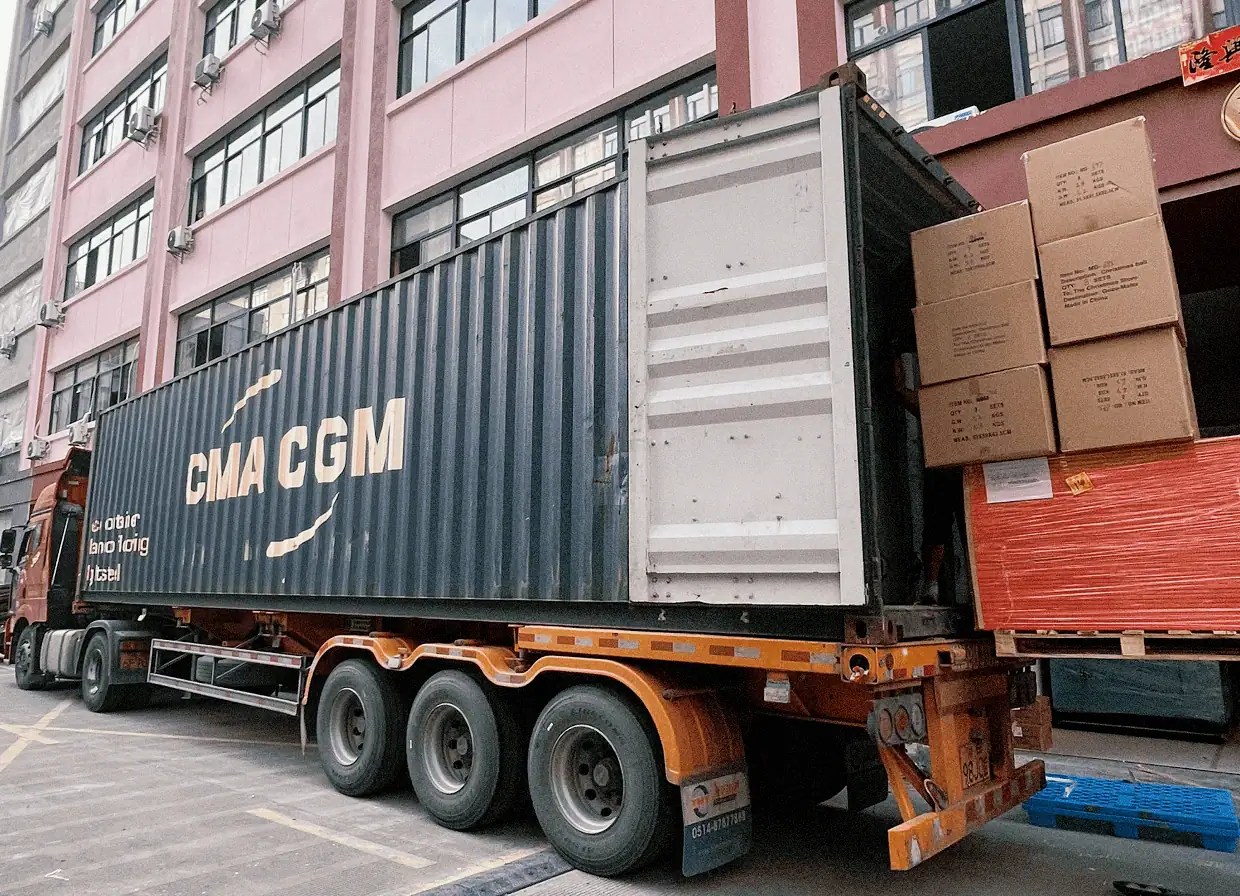
Loading should consider weight, strength, unloading order and damage risk.
- Distribute heavy items and secure them against movement.
- Do not place rigid pressure points against upholstery.
- Keep fragile cartons away from areas where heavy items may shift.
- Use partitions or protective material where different package types meet.
- Place urgently needed or easily identifiable items according to the unloading plan.
- Photograph key stages of the load for the receiving team.
A good load uses space well without making the lightest products support the heaviest ones.
Control Moisture and Container Condition
Check the container floor, walls, roof and door seal before loading. It should be dry, clean and free from strong odor or visible damage.
Long sea journeys can expose goods to temperature changes and condensation. Packaging and moisture-control decisions should match the materials, route and season. Do not use one generic quantity of desiccant for every shipment without considering the load.
Prepare the Destination Team
Send the final packing list, container loading photos and item-to-room map before arrival. The receiving team needs to know which crates require tools, which packages contain installation hardware and which items should be opened first.
DDP delivery can simplify transport responsibility, but it does not replace site-access planning. Confirm truck access, unloading equipment, labor, storage space and local installation separately. Our overview of container shipping from China covers the freight terms behind that decision.
What Happened in a Minden Intl Full-House Project
Minden Intl coordinated 105 pieces in eight product categories from 19 factories for one residential project. The shipment combined furniture and decorative categories in a 40HQ container and was delivered under a DDP arrangement.
The team checked actual stone slabs and inspected furniture before wooden crates were closed. Confirmation took about 11 weeks, followed by roughly eight weeks from production through sailing.
Those facts describe one project. They do not set a universal timeline or loading formula. They show why mixed home-furnishing consolidation must connect approvals, packing, warehouse receiving and the final load plan.
For the factory side of an order like this, see our furniture sourcing agent service.
Read the full Luxury Home Furniture case study.
Mixed Furniture Container Checklist
- Final item and supplier list
- Expected and final packing dimensions
- Handling class for every package
- Supplier completion and warehouse windows
- Project-wide carton and crate labels
- Receiving count and condition record
- Inspection timing before crate closure
- Real packed CBM and stackability review
- Weight distribution and loading sequence
- Container condition and moisture plan
- Destination unloading and room map
Frequently Asked Questions
Yes. Their goods can be delivered to a consolidation warehouse, checked, recorded and loaded together. The main work is aligning dates, labels, packing data and the final load.
Can artificial plants be loaded with furniture?
Yes, provided they are protected from crushing and planned around the heavier packages. Their packed shape and recovery after unpacking should be considered.
How much spare container space should I leave?
There is no universal percentage. Use final package dimensions, stackability, weight distribution and the warehouse’s loading assessment. Spreadsheet CBM alone is not enough.
What is the difference between calculated CBM and usable container space?
Calculated CBM is the sum of every package’s length × width × height. Usable space is what remains after stackability, weight distribution and protection gaps are applied. On a mixed furniture container the two figures diverge more than on a single-product load, because crush-sensitive and rigid packages cannot be stacked interchangeably.
When should final inspection happen?
Inspection should happen after production is complete and before packaging prevents access. Leave time for correction before warehouse delivery and loading.
Do all suppliers need to deliver on the same day?
No, and asking them to usually makes things worse. A warehouse delivery window works better: it leaves time to receive, count and correct without goods sitting unprotected for weeks. Track production completion, inspection readiness and warehouse delivery as three separate dates.
What happens if one supplier misses the warehouse window?
Either the load ships without that item, the item follows separately at extra cost, or the whole booking moves and every other supplier’s goods accrue storage. Deciding the rule in advance is cheaper than deciding it during the delay.
Who decides the loading sequence?
The warehouse, working from the final packing list and the handling class assigned to each package. A sequence worked out at the container door wastes space and puts fragile cargo in the wrong place.
Planning a Mixed Furniture Container?
Send Minden Intl your supplier list, estimated quantities and destination requirements. We will review packing data, warehouse timing, inspection points and the container-loading risks before the shipment is locked.