If you already sell a product and need more of it, you do not need product development. You need a factory that can manufacture a product from a sample: take the physical item you send, understand it and make it again at a price your order volume can carry. The process, the risks and the questions are different from developing something new.
This guide walks through that process using a real project: a Swiss chair-parts supplier who sent us one wooden chair base and needed a matching base for a first order of 150 sets. You can read the full wooden chair base case study for the whole story.
Before You Manufacture a Product from a Sample, Check Your Rights
Sending a sample to a factory is common, legitimate business when the design is yours, when you have permission from the rights holder, or when the item is a generic part with no protected design. It is not legitimate when the product is protected by a design right, trademark or copyright you do not hold.
Check this before you send anything. Protected designs can be seized at customs, removed from marketplaces and lead to legal claims. A good sourcing agent will ask the question too, and will decline work that copies a protected design.
In the chair base project, the client is a parts supplier who needed bases that fit his existing chairs. The task was to match his part, not to copy a branded product.
Step 1: Send the Physical Sample, Not Just Photos
The client first contacted us on May 18. He was busy, and for several weeks there was no clear instruction. We stayed in touch without pushing. On June 22 he decided the clearest brief was the product itself and shipped us the sample.
That decision saved time later. When you make a product from a sample, the sample answers questions that photos and drawings leave open:
- Material and finish: wood species, color, surface texture and coating.
- Dimensions and tolerances: leg taper, length and the exact positions of holes.
- Structure: how legs, brackets, cross-brace, screws and glides fit together.
- Hidden details: thread types, fitting thickness and the parts nobody thinks to photograph.
Before you ship, write down which details must match exactly and which can change. That list becomes the brief every factory quotes against.

Step 2: Test the Material Against Your Budget
This is where most sample-based projects get stuck. The client asked for walnut or oak, matched one to one. When we searched online, most factories that make this type of base did not stock walnut or oak. They worked mainly in beech. We then had a sourcing partner in Guangdong take the sample to factories in person to test the walnut and oak route.
After comparing factories, walnut and oak meant a high sample cost and a high minimum order. For a first order of 150 sets, the budget did not stretch that far.
We had two choices: tell the client it could not be done, or find a route that kept what mattered. We went back to the online beech factory, which had a lower minimum order and a lower sample fee, and put both options in front of the client with the real differences explained.
The trade-off, stated honestly
| Factor | Walnut / oak (original) | Beech (alternative) |
|---|---|---|
| Cost and MOQ for 150 sets | High sample cost and high minimum order | Lower sample fee and lower minimum order |
| Hardness | Black walnut is relatively soft for a hardwood; oak is harder | Hard and strong, harder than black walnut and close to oak |
| Grain and color | Walnut has distinctive dark figure | Fine, even grain without dark figure; color comes from staining, so the difference shows up close |
| Movement with humidity | More stable | Moves more as humidity changes, so moisture content must be controlled |
Published figures from The Wood Database put European beech at 1,450 lbf on the Janka hardness scale and black walnut at 1,010 lbf. Beech also has a large amount of movement in service, which is why moisture control matters.
So beech was not a perfect substitute. It was the best fit for the budget: the base matches the sample’s look, dimensions and structure, at the cost of a different grain up close and closer attention to moisture. The client weighed that and chose beech.
Step 3: Understand How the Quote Is Built
A quote for a sample-based part is usually several costs in one. In this project, the quotation had four parts:
- Unit price at two volume tiers, with a lower price at the higher volume.
- A mold fee for metal parts that need their own tooling. At the higher tier, the factory offered to cover half of it.
- A wooden sample fee of a few hundred US dollars.
- A sampling sequence: hardware that needs new molds can only be sampled once those molds exist.
When you compare factories, separate one-off costs (molds, samples) from repeat costs (unit price). A factory with a low unit price and a high mold fee may cost more on a small first order than one with the opposite structure.
If you are not sure whether your project is sourcing or development, our article on product sourcing vs product development explains the difference, and product development in China covers projects that start from an idea instead of a sample.
Step 4: Approve with a Side-by-Side Comparison
Once the client paid the sample fee, we sent his original to the beech factory. During sampling we kept checking details with him so the new sample would look as close as possible to the original to the naked eye.
When the sample was ready, we did not just say it was done. We sent comparison photos with the new sample next to the original, plus a detail video. Seeing the two side by side answers questions that a written description cannot.
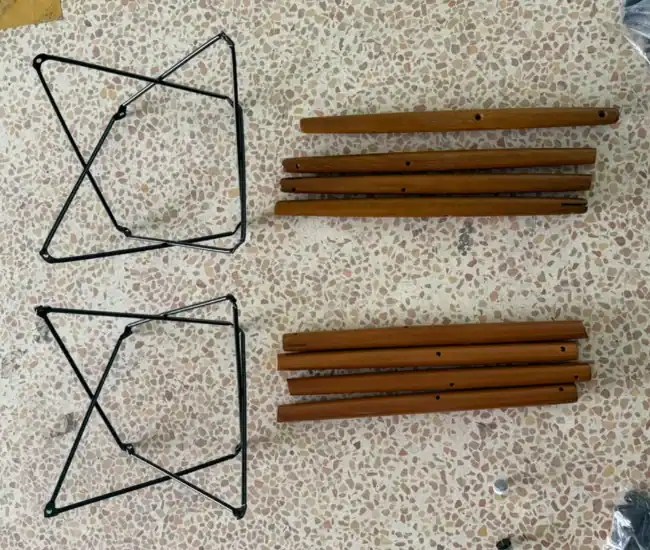
The client replied “Perfect. Pls ship,” and we sent the sample to him. He has since approved its overall workmanship and appearance, with a few small details being fine-tuned before the bulk order. For a fuller approval process, see our guide on sample management in China sourcing.
Questions to Ask Before You Commit to an OEM from Sample Project
Every OEM from sample project involves choices like the one above. Before you approve a route, put these questions to your factory or agent:
- Is there a stock version that already fits? Many common parts exist off the shelf. If one matches your critical dimensions, it may beat a custom run on cost and lead time.
- Which details are truly critical? Fit and structure often matter more than material. Decide what must match exactly before you pay for an exact match on everything.
- What does the original material cost at your quantity? Ask for the sample fee and MOQ in the original material and in an alternative, so you can see the gap.
- Which parts need tooling? Molded or stamped parts add one-off costs and change the sampling order.
FAQ
Can a Chinese factory manufacture a product from a sample?
Yes, if the design is yours or not protected. Send the physical sample with a list of the details that must match, ask for quotes against that list, and approve a pre-production sample before the bulk order.
Should I send a physical sample or drawings?
Send the physical sample when you have one. It shows material, finish, tolerances and how parts join. Add drawings or measurements for the dimensions that must not change.
What if the original material is too expensive for my order size?
Ask the factory to quote an alternative material alongside the original, with the differences in appearance, strength and stability explained. Then decide based on which details matter most to your customers.
This guide is based on a real project. Read the full case study on sourcing a wooden chair base from China →
Have a sample you need made?
Send us photos of your sample, your target quantity and the details that must match. We will check which factories can make it and which material options fit your budget.