Choosing a sourcing agent is the first decision. Knowing how to work with a sourcing agent after you hire one decides whether the relationship saves you time and money for years, or turns into another source of surprises.
This guide is about the working relationship itself: what to send at the start, how to communicate, which tools and documents keep a project under control, how to handle samples, production and inspection, and how to review an agent’s performance. If you are still choosing an agent, start with our checklist on how to choose a reliable sourcing agent in China.
How to Work with a Sourcing Agent: Agree the Scope First
Most problems with sourcing agents come from different assumptions about what the agent is responsible for. Before the first project, agree in writing:
- Which services are included: supplier search, verification, negotiation, samples, production follow-up, inspection, consolidation, shipping.
- How the agent is paid and whether it receives any other income connected with your order, such as a margin on the unit price or freight.
- Whether you will know the factory and whether you may contact it directly.
- Confidentiality: who owns your designs, files and supplier information.
- What happens when goods fail inspection: who decides on rework, re-inspection or rejection, and who pays.
Send a Complete Brief
An agent can only be as precise as the information you give. A good first brief includes:
| Item | What to include |
|---|---|
| Product | Photos, drawings or a physical sample; materials, dimensions, colors |
| Quantity | First order, expected reorders, quantity per color or size |
| Price | Target price or budget, and which costs it should include |
| Branding and packaging | Logo files, packaging type, labels and inserts |
| Market requirements | Destination country, certifications, labeling rules, sales channel such as Amazon |
| Timing | When you need the goods, and the latest date you can accept |
Our private label product checklist shows how one Amazon seller structured a brief that let factories quote on the same basis.
Set Up Communication That Works Across Time Zones
- One main channel for decisions. Use email or a shared document for anything that changes price, specification or timing. Quick chat apps such as WhatsApp or WeChat are fine for updates, but confirm decisions in writing.
- A fixed update rhythm. For example, a weekly status during sourcing and sampling, and more frequent updates when production is running or a problem is open.
- Clear escalation rules. Agree which events need an immediate message: a delay that affects your ship date, a failed inspection, a change of material or factory.
- A named backup. Know who covers when your main contact is away.
Tools and Documents That Keep a Project Under Control
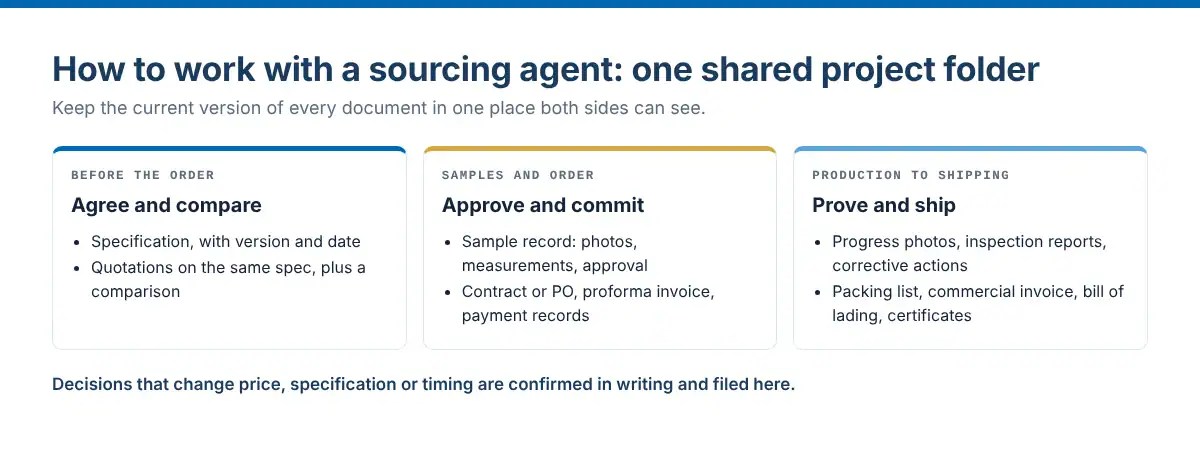
When buyers ask how to work with a sourcing agent day to day, the answer is mostly documents, not software. You do not need special software. You need one place where the current version of everything lives. A shared folder with a simple naming system works for most buyers:
- Specification: one document, with a version number and date, that both sides work from.
- Quotations: each supplier’s quote on the same specification, plus a comparison.
- Sample record: photos, measurements, your comments and the approval.
- Order documents: contract or purchase order, proforma invoice and payment records.
- Production and inspection records: progress photos, inspection reports and any corrective actions.
- Shipping documents: packing list, commercial invoice, bill of lading and certificates.
State the shipping term on every purchase order, using the ICC’s Incoterms rules, so both sides know where cost and risk pass to you.
For video calls and factory tours, any common tool works; what matters is that tours are live and show your product being made. For payments, pay only the company named on the contract, by bank transfer or another traceable method, and verify bank details by a second channel before the first payment.
Samples: Approve One, Then Protect It
The approved sample is the reference for everything that follows. Ask the agent to keep one sealed approved sample in China and send you an identical one, record every change requested between sample rounds, and confirm in writing which version is approved. Read more in our guide to sample management in China sourcing.
Production: Ask for Evidence, Not Reassurance
During production, useful updates are specific: what percentage is cut, sewn or assembled; photos of the actual goods; any material or schedule changes. “Everything is fine” is not an update. When something goes wrong, a good agent tells you early, explains the options and their cost, and records your decision. You can see what that looks like in our private label women’s tops case study, where daily reports kept a delayed 20,000-piece order under control.
Inspection Before the Balance Payment
Agree when the inspection happens, what it checks and what happens if goods fail, before production finishes. Pay the balance only after you have seen the report. Our quality inspection service works from your approved sample and specification.
Review the Agent’s Performance
Knowing how to work with a sourcing agent also means reviewing the work. After each order, or every few months for ongoing work, review the relationship on facts:
- Were goods delivered on time, and to the approved standard?
- Were problems reported early, with options?
- Did landed costs match the quotation?
- Are records complete enough that someone else could follow the order?
Share the review with your agent. Good agents use it to improve; the conversation also shows you how they respond to criticism.
Scaling Up with the Same Agent
Once you know how to work with a sourcing agent on one product, the agent’s role can grow with your business: more products, more suppliers, and consolidation of several suppliers into one shipment through a consolidation warehouse. Add scope step by step, after each new service has worked once on a real order.
If the Relationship Isn’t Working
Raise specific problems in writing and agree what will change. If nothing improves, end the relationship cleanly: collect all project files, specifications and supplier details you are entitled to under your agreement, and settle open orders before moving to a new agent.
FAQs: How to Work with a Sourcing Agent
How often should my sourcing agent update me?
Agree a fixed rhythm, often weekly during sourcing and sampling and more often during production. Problems that affect price, quality or timing should be reported immediately.
Should I sign an NDA with my sourcing agent?
For custom or private label products, yes. A written agreement should cover confidentiality, ownership of designs and files, and how supplier information is handled.
Can I contact the factory directly while using an agent?
Agree this at the start. Many buyers keep the agent as the main channel during production to avoid conflicting instructions, but know who the factory is.
Do I need to visit China?
No. A good agent visits factories and sends live video and photos on your behalf. A visit can help build relationships with key suppliers, but it is optional.
Looking for an agent you can work with long term?
See how our China sourcing agent service works, or send us your first brief and we will tell you what is missing before we quote.