Toys sold in the Gulf need more than a good price and a safe design. They need GCC toy certification: conformity with the Gulf technical regulation on toys and the G-Mark on the product. Many importers who know EN 71 or CPSIA find the Gulf rules unfamiliar, especially the Arabic labelling and the documentation the importer must keep.
We work through these rules with a start-up children’s gift-set brand in Oman. Its certificate requirements are strict, and compliance shapes which products it can choose in the first place. This guide covers what we have learned, with links to the official sources.
What GCC Toy Certification Means
The Gulf Standardization Organization (GSO) issues a technical regulation on toys that applies across the GCC member states. Toys covered by it must conform before they are placed on the market, and they carry the Gulf Conformity Mark, known as the G-Mark (written “GC marking” in the regulation text).
According to the GSO’s page on the GCC Conformity Mark, the G-Mark shows that a product meets the requirements of the relevant Gulf technical regulation. It is not a quality mark: it signals conformity with safety requirements, not that one toy is better than another. The mark is shown together with the identification number of the notified body involved.
Which Toys Are Covered
The GSO toy regulation, formally the GSO Technical Regulation on Toys, applies to products designed or intended for use in play by children under 14 years old. For a children’s gift-set brand, that usually covers the toys and play items in the set: anything a child is expected to play with. Items that are not toys may fall under other regulations and should be checked separately.
G-Mark Requirements: What the Importer Must Know
| Requirement | What it means in practice |
|---|---|
| Type examination | A notified body examines the toy and issues a type examination certificate |
| Declarations of conformity | Declarations from the manufacturer and the importer, in Arabic and English |
| Warnings | In Arabic, starting with the word “Warning” or “Warnings”; age warnings visible before purchase, including when sold online |
| Instructions | Instructions for use and safety information in Arabic |
| Records | Technical documentation kept for 10 years |
| Responsibility | The importer is responsible for the conformity of the consignment it places on the market |
In practice, importers often call this package the G-Mark certificate, but it is several documents, not one. The last point matters most. A factory’s EN 71 report from another market does not move responsibility away from the Gulf importer. The importer needs documents that meet the Gulf regulation.
How GCC Rules Differ from EN 71 and CPSIA
If you already import toys into Europe or the US, much of the safety testing will be familiar. The differences are in the paperwork and labelling: the G-Mark, the notified body, declarations in Arabic and English, and Arabic warnings and instructions. For the European and US rules, see our guide on importing toys from China.
Do not assume an existing test report will be accepted. Ask the notified body which reports it can use and what additional tests or documents it needs.
A Real Example: Compliance First, Then Products
For the Oman client, certification was not a step at the end. It came first:
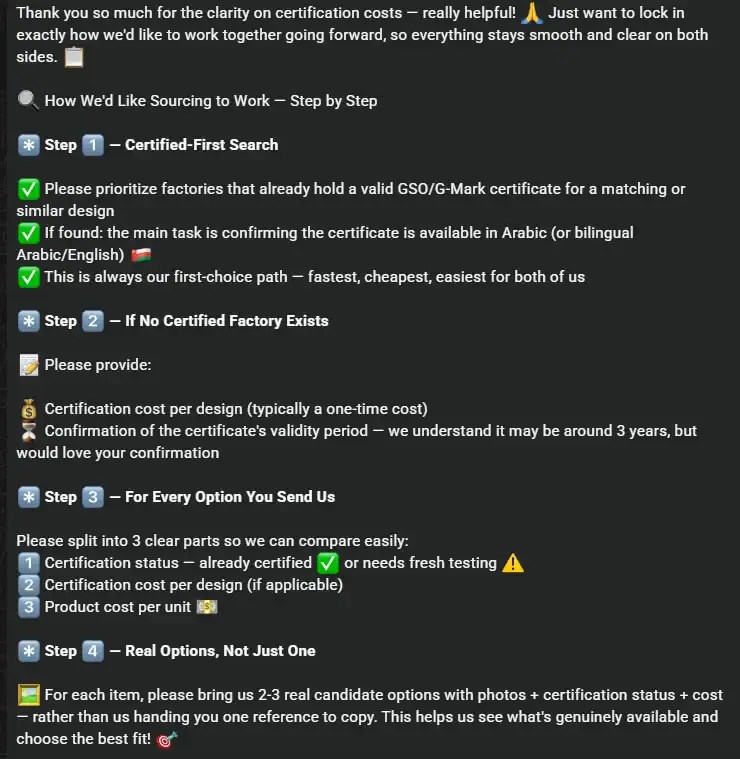
The client set out its preferred way of working in writing, step by step:
- Certified first: look first for factories that already hold a valid G-Mark certificate for a matching or similar design, and confirm the certificate is available in Arabic or bilingual Arabic/English.
- If no certified factory exists: report the certification cost per design and confirm how long the certificate stays valid.
- For every option: show certification status, certification cost per design and unit price as three separate items, so options can be compared.
- Real options, not one: 2–3 real candidates per item, with photos, rather than one copy of a reference image.
In practice, that meant:
- Certificates defined the shortlist. The client specified which third-party testing labs it would accept. We contacted those labs to ask about the process, timing and cost of certification for the products under consideration.
- Product selection followed compliance. Certification questions were answered before products went further into samples and negotiation.
- Labelling planned up front. Arabic warnings and instructions affect packaging design, so they had to be planned before any packaging artwork.
The gift sets combine several small items, such as DIY canvas painting kits, air-dry clay and alphabet bead keychains. Each item needs its own check. The client also asked us to avoid licensed characters in designs: a cartoon character on a toy raises intellectual property questions on top of safety ones.

A Chinese domestic label is not a Gulf label. Many toys made for China carry warnings in Chinese and marks for Chinese standards. That does not meet the Arabic labelling requirement, and those warnings and instructions need to be redone for the Gulf market.

For a small brand, this order of work saves money. A toy that cannot be certified economically is not a bargain, however low the factory price. For small toys sourced in volume, see also our guide to sourcing fidget toys from China.
Checklist Before You Order Toys for the Gulf
- Confirm the product is a toy under the GSO regulation (intended for play by children under 14)
- Choose testing labs and a notified body, and confirm what they will accept
- Get certification cost and timing before choosing products
- Plan Arabic warnings and instructions into the packaging artwork
- Prepare manufacturer and importer declarations in Arabic and English
- Set up a system to keep documentation for 10 years
This guide summarizes the GSO Technical Regulation on Toys and the GSO’s official pages. Requirements can change, so confirm current rules with the GSO and your notified body before ordering.
Sourcing toys for the GCC market?
We start with compliance: we check certification routes with your chosen labs before shortlisting products, then plan Arabic labelling into the packaging.