Many buyers try to find fabric from a sample using only the numbers printed on a label or an old order: composition, weight and width. Those three numbers narrow the search, but they do not describe how a fabric looks, feels or behaves. Two fabrics can match on all three and still be wrong for your garment.
This guide explains which specs are usually missing, how a physical swatch closes the gap, and how to judge an exact match against a close alternative. It is based on a real order for a women’s apparel factory in Ecuador; the full fabric sourcing case study covers the whole project.
Why Composition, Weight and Width Are Not Enough
Composition tells you the fibers, such as cotton, modal or spandex, and their percentages. Fabric GSM tells you the weight in grams per square meter. Width tells you how much usable fabric comes off each meter of the roll.
None of them tells you:
- How fine or coarse the yarn is
- Whether the fabric is knitted or woven, and in what structure
- How it was finished after knitting or weaving
Those missing details decide the surface, the drape, the stretch and the hand-feel. In our client’s case, the brief had only composition, weight and width, and the client could not supply the rest. Working from those three numbers alone would have produced fabrics that matched on paper but not in the hand.
Fabric Specifications for Sourcing: What Decides Look and Feel
| Spec | What it controls | What goes wrong if it is missing |
|---|---|---|
| Composition | Fiber types and percentages | Usually given; rarely the problem on its own |
| Weight (GSM) | Thickness and body | Usually given; the same GSM can still feel very different |
| Width | Usable fabric per meter, cutting efficiency | Usually given |
| Yarn count | Fineness, smoothness, surface sheen | A coarser or finer yarn at the same weight looks and feels different |
| Knit or woven, and structure | Stretch, drape, texture (jersey, rib, interlock; plain, twill) | The factory may offer a different structure with the same composition |
| Finishing | Hand-feel, softness, surface (brushed, peached, washed) | The fabric feels harsher or softer than expected |
The biggest split is knit vs woven fabric. Knits are made of interlocking loops and stretch easily; wovens are made of crossing yarns and are usually more stable. If a supplier does not know which one you need, nothing else in the brief will save the match.
Weight is also worth checking the same way on every sample. Fabric weight is measured as mass per unit area, and there are standard test methods for it, such as ASTM D3776. Make sure you and the supplier quote weight on the same basis.
How to Find Fabric from a Sample: Send a Swatch, Not Just Numbers
When the specs are incomplete, the fastest fix is a physical fabric swatch. In this project, we explained the risk of working from three numbers and asked the client to mail a swatch. Once it arrived, we sent it to the candidate factories and asked them to match it on four points:
- Surface texture: the visible structure and finish.
- Thickness: how heavy and dense it is in the hand.
- Stretch: how far it stretches and recovers, and in which directions.
- Hand-feel: softness, smoothness and drape.
A factory comparing a real swatch can usually identify the yarn, structure and finishing on sight and by touch. That is the information the written brief was missing.
Exact Match or Close Alternative?
Aim for an exact match first. For specs that are hard to find in stock, ask for a close alternative in parallel: similar composition and hand-feel, with the differences stated. That way a missing exact match does not stall the order.
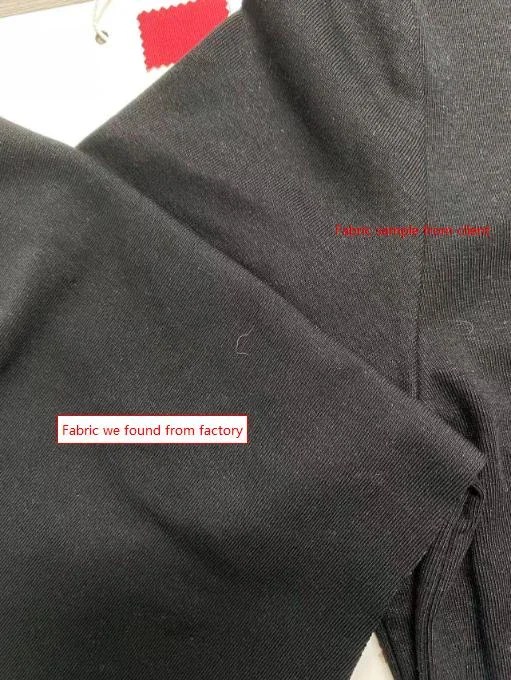
Judge the result side by side, under the same light, and handle both pieces. In our case, the factory found the same black fabric as the client’s sample, and the client accepted it.
Compare Offers on the Same Basis
Once several factories have matched the swatch, compare them in one sheet:
- Exact match or alternative, and what differs
- Price
- Minimum order quantity
- Lead time
- A physical swatch card for each option
Before you commit to a new mill, check it the same way you would any supplier; see how to verify a Chinese supplier.
Swatch cards matter because a photo cannot show thickness, stretch or hand-feel. For more on handling samples once a match is chosen, see sample management in China sourcing.
Keep the Full Specs for Next Time
When a match is confirmed, ask the supplier to write down the full specification: composition, weight, width, yarn count, structure and finishing. Next time, you can order to a complete spec sheet instead of mailing another swatch. If your product is not fabric, the same principle applies to other items; see how to manufacture a product from a sample.
FAQ
Can a supplier find fabric from a sample without any specs?
Often, yes. A physical swatch lets the factory identify the structure, yarn and finishing. Composition, weight and width still help narrow the search, so send them if you have them.
What is fabric GSM?
GSM is the fabric’s weight in grams per square meter. It shows how heavy the fabric is, but two fabrics with the same GSM can look and feel different because of yarn, structure and finishing.
Should I accept a close alternative?
Only after comparing it side by side with your sample and checking it against the features that matter most for your garment, such as stretch, thickness and hand-feel.
This guide is based on a real fabric order. Read the full case study on fabric sourcing from China →
Have a fabric swatch you need to match?
Tell us the specs you have and send us the swatch. We will match it with fabric factories in China and compare exact matches and alternatives on price, MOQ and lead time.