On paper, this custom exhibition furniture manufacturing in China order looked routine. The client had ordered from Minden before, and the samples for the 72″ Bali Bar passed without a single note. Then the full order of 20 units got loaded into the container — and one bar came apart at the leg.
That’s the strange part of custom exhibition furniture manufacturing in China: a design can pass every sample check and still fail at production volume, because the thing that breaks it isn’t the material or the finish. It’s the design itself, under a kind of load a single sample never experiences.
A Repeat Client, A First-Time Custom Build
The client is a US-based exhibition and trade show furniture rental company — the kind of business that owns hundreds of pieces and cycles them through booths at conventions all year. They’d worked with Minden as their China sourcing agent on standard rental inventory before. This order was different: a fully custom piece, the 72″ Bali Bar, built to their spec in a Formica white matte finish, quantity 20 for the first run.
Custom work for a repeat client changes the dynamic. There’s already trust in the relationship, which matters a lot once something goes wrong — and on this order, something did. It’s also a scenario that comes up often in custom exhibition furniture manufacturing in China: the first custom run with a factory is where design assumptions get tested, even when the buyer relationship itself is already established.
Why the One-Piece Design Was the Real Problem

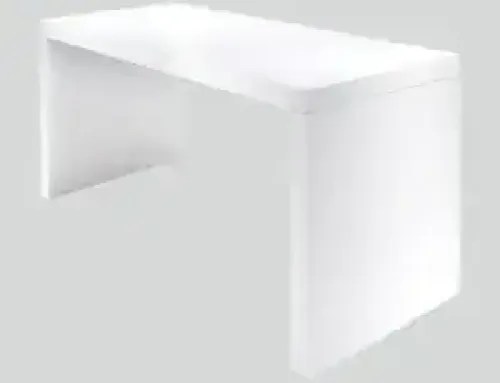
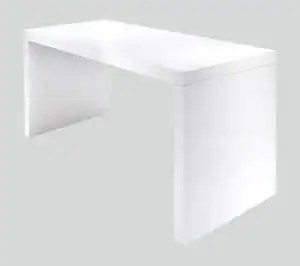
The first version’s 3D model — one continuous frame, top and legs built as a single rigid piece.
The first sample shipped clean. No structural notes, no finish issues, approved and signed off. The risk was invisible at sample stage because a single unit doesn’t get racked, restacked, and cross-shipped the way a full order does.
It surfaced during container loading. Of the 20 units, one bar had a leg that cracked — even packed inside a wooden crate — and two more had cosmetic defects, chipped edges and minor surface marks. Crating is the standard protection for furniture this size. When a piece fails inside a crate, that’s usually not a transit-damage story. It’s a construction story: the bar was built as one continuous piece, top and legs as a single rigid frame, with no give anywhere along its length. Under the weight and pressure of full container loading, that rigidity has nowhere to go except the weakest point — the leg joint.

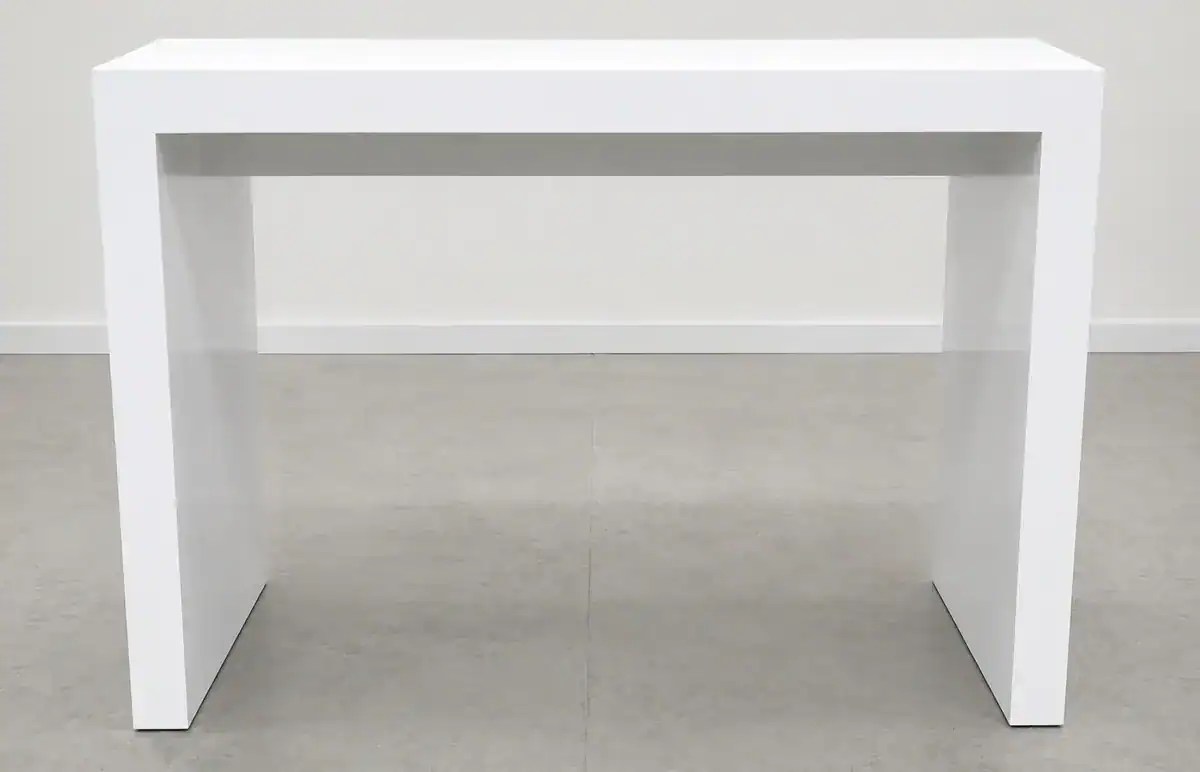
The approved sample of the original one-piece bar — no structural issues flagged at this stage.
This is common with custom-built furniture that’s designed for how it looks in a booth, not for how it holds up under its own weight and the weight around it in a container. Factories build exactly what’s on the drawing. Nobody upstream is checking whether that drawing can take the load of a full production run, crated or not. It’s one of the least visible risks in custom exhibition furniture manufacturing in China, because it never shows up until the order scales past a single sample.
What Inspection at Container Loading Actually Caught

The crack found during container loading — visible stress fracture at the leg joint, despite crate protection.
The defects weren’t caught in a routine pre-shipment inspection — they surfaced during container loading itself, when the units were being handled and packed into the FCL. That’s a detail worth sitting with: pre-shipment inspection checks a sample subset in controlled conditions. It doesn’t always replicate the stacking, strapping, and repositioning that happens during actual loading.
For one-piece furniture designs especially, loading conditions are often the real stress test — not the inspection that happens before it.
Why the Fix Wasn’t a New Supplier
The damaged and defective units were Minden’s responsibility to resolve, not the client’s problem to absorb. Compensation was arranged with the client for the cracked unit and the two with cosmetic defects before anything else happened.
Only after that was settled did the conversation turn to the actual fix. Because this was a repeat factory relationship, that conversation moved faster than it would have with a new supplier — the factory already understood the client’s finish standards and tolerances from the first run, and there was no time lost vetting a new production partner mid-order. The redesign came out of that: not a new supplier, but a new design built with the same factory. The complete sequence from defect evidence to controlled redesign and repeat-order verification is documented in our supplier corrective action plan guide.
From One Piece to Three: The Redesign That Cut Volume by Two-Thirds

The redesign drawing — three modular sections joined with cam lock and dowel hardware instead of one rigid frame.
The original one-piece bar shipped at roughly 1.5 CBM per unit. The redesign split the bar into three modular sections — top, and two leg assemblies — that connect on-site using cam lock and dowel hardware instead of being built as one rigid frame.

Modular panels in production, showing the cam lock and dowel joinery that replaced the one-piece frame.
The new packed volume: 0.5 CBM per unit. A 67% reduction, with no increase in unit cost.
Splitting the piece did more than solve the crack risk. Each section now packs flat, so there’s far less unsupported span to crack under transit stress in the first place — the failure mode from the first order structurally can’t repeat itself, because there’s no single long piece to twist. The client also asked for a cable and wire grommet hole to be added to one leg during the redesign, giving each bar a built-in pass-through for power at booth setup. A functional upgrade added at the same time the defect was being fixed, at no added cost. The wider method is explained in how to design furniture for export shipping before finalizing the box.
The finished modular bar, assembled — same look as the original, none of the structural risk.
Why Sea Freight FCL to Chicago Was the Only Real Option
At 20 units and later 50, air freight was never a realistic option for furniture of this size and weight. The order shipped sea freight, full container load, DDP to Chicago — landed cost, cleared, and delivered under US customs requirements with no separate clearance handling required on the client’s end.
DDP matters more for rental furniture companies than most buyers realize. Their business runs on inventory being available for the next booking, not sitting in a bonded warehouse waiting on paperwork — a logistics detail that’s easy to overlook when evaluating custom exhibition furniture manufacturing in China purely on unit price.
The Repeat Order Is the Real Result
The client received the redesigned units and was satisfied — smaller packed volume, added grommet function, same price point. The next order wasn’t for 20 units. It was for 50.
That’s the number that matters more than the defect count from the first run. A design flaw caught at full production, resolved with compensation and a factory that already knew the client’s standards, turned into a product line the client now expects to reorder on a stable, recurring basis. It’s the outcome buyers actually want from custom exhibition furniture manufacturing in China — not a defect-free first run, but a supplier relationship that holds up once something does go wrong.
The Real Lesson From a Broken Leg
A crate is not a design fix. Buyers often treat heavier packaging as insurance against structural risk, and sometimes it is — but not when the risk is built into the joint itself. What actually solved this wasn’t better protection. It was fewer places for stress to concentrate.
What This Case Study Shows About Custom Exhibition Furniture Manufacturing in China
Sample approval is not the same as production-readiness. A single unit built and inspected by hand doesn’t experience the handling stress of twenty units being stacked, wrapped, and loaded together — and for large one-piece furniture, that gap is exactly where structural risk hides. Buyers sourcing custom exhibition furniture manufacturing in China should ask suppliers directly how a design will be packed and handled at full order volume, not just how the sample looked.
Modular construction isn’t only a packaging decision — it’s a risk decision in custom exhibition furniture manufacturing in China. Splitting a large piece into sections that assemble on-site with hardware like cam locks and dowels reduces the unsupported spans that crack under transit stress, cuts CBM, and often lowers freight cost per unit, all without touching the finish or the design intent the client actually wanted.
The other detail buyers tend to miss: a defect found during loading isn’t automatically a factory workmanship failure. Sometimes the factory built the drawing correctly and the drawing itself was the problem. Staying with a trusted sourcing partner through a defect, rather than switching suppliers mid-order, is often what makes a fast redesign possible in the first place — and it’s the single biggest factor separating reliable custom exhibition furniture manufacturing in China from a one-off transaction.
For the practical workflow behind similar projects, see how to source custom exhibition furniture in China.
Let Us Handle All Your China Import Work
Whether you’re building custom exhibition furniture or sourcing other wholesale products, our experienced sourcing team handles everything from design review and sample making to bulk order contracts, inspection, and final delivery.
FAQ
What is custom exhibition furniture manufacturing in China?
It’s building trade show and booth furniture — bars, counters, display units — to a client’s own design specifications rather than ordering from a factory’s standard catalog, typically produced by furniture factories in the Guangzhou/Foshan region.
Why did the exhibition bar crack if the sample passed inspection and it was crated?
The sample was a single unit handled once, under controlled conditions. Crating protects against rough handling, but it can’t compensate for a rigid one-piece design with no give along its length — the full order of 20 units exposed that under real loading stress.
Is a defect found during container loading a factory quality issue?
Not always. In this case, the factory built the design correctly — the one-piece construction itself was the structural liability, not workmanship. Distinguishing the two determines whether the right response is compensation and a redesign, or a new supplier.
Does modular furniture design increase manufacturing cost?
Not necessarily. In this case, splitting one piece into three modular sections cut packed volume by two-thirds with no increase in per-unit cost, and left room to add a functional upgrade — a cable grommet hole — at the same time.
Why ship custom exhibition furniture DDP instead of standard freight terms?
DDP delivers the furniture cleared and landed at the client’s door, which matters most for businesses like exhibition rental companies that need inventory ready for the next booking rather than sitting in customs.