Most seasonal schedules fail at the same point. The buyer asks when to start, receives a month as an answer, and treats that month as a plan.
A Christmas product sourcing timeline is not a starting month. It is a set of dates that named parties have confirmed, each one tied to the work it depends on and to the decision that follows if it moves.
There is no single starting month that works for every seasonal order. Buying an existing ornament with unchanged packaging is different from developing a decoration from a reference photo. A repeat order also needs a fresh check of materials and capacity; last year’s approved sample does not reserve this year’s components.
This guide is for importers, wholesalers and retail buyers planning a seasonal range. It explains how to build a schedule you can use to make buying decisions, including how to recognise — early enough to act — that a promising product no longer fits the selling window.
Start with the commercial deadline
Write down three separate dates: the launch or on-shelf date, the date your warehouse needs the goods, and the latest acceptable arrival if the plan slips. These are different commitments, and merging them produces a schedule nobody can defend.
A port arrival estimate is not a warehouse delivery promise. Receiving, checks, local transport, labeling and allocation to stores may still remain. Ask your receiving team what must happen before the stock can actually be sold.
For US-bound cargo, entry filing and release sit between arrival and delivery as well. CBP’s basic importing guidance sets out what has to happen before goods can leave customs custody.
Your starting brief should include:
- Product list, intended use and destination market.
- Quantity by style, color and size, with essential items identified.
- Existing stock, a modified design or a new custom development.
- Retail-ready packaging and any labeling requirements.
- Destination warehouse and required receiving date.
- The person who can approve samples, changes and commercial decisions.
If one deadline is flexible, say which one. A buyer who can reduce the assortment has a different set of options from a buyer whose complete range must launch together.
Build the Christmas product sourcing timeline backward
Use the following checkpoints in reverse order. Enter dates only after the responsible parties have reviewed the assumptions. The table describes a planning method, not standard lead times or a delivery guarantee.
| Checkpoint | What must be confirmed | Who supplies the input |
|---|---|---|
| Stock ready to sell | Receiving, local checks, labeling and store or customer allocation complete. | Buyer and destination warehouse |
| Delivery to the warehouse | Transport plan, destination handling and receiving appointment, with uncertainty visible. | Forwarder and receiving team |
| Cargo ready for shipment | Accepted goods, packing details, documents and the applicable booking cutoffs. | Supplier, sourcing team and forwarder |
| Inspection and corrective work | Inspection scope, acceptance reference and time for corrections and another check if needed. | Buyer, supplier and inspection team |
| Production complete | Quantity, confirmed materials, capacity, packing and an agreed completion date. | Supplier |
| Production released | Approved sample and specifications, packaging, order terms and agreed start conditions. | Buyer and supplier |
| Samples approved | Review method, decision owner, revision path and any unresolved differences. | Buyer and development team |
| Brief and supplier confirmed | A buildable design, suitable manufacturing process and an agreed sampling scope. | Buyer, sourcing team and supplier |
For each checkpoint, record a target date, the current confirmed date, its dependency and the next decision needed. An empty field is an unresolved input, not spare time. A schedule with three empty fields is an estimate, not a plan.
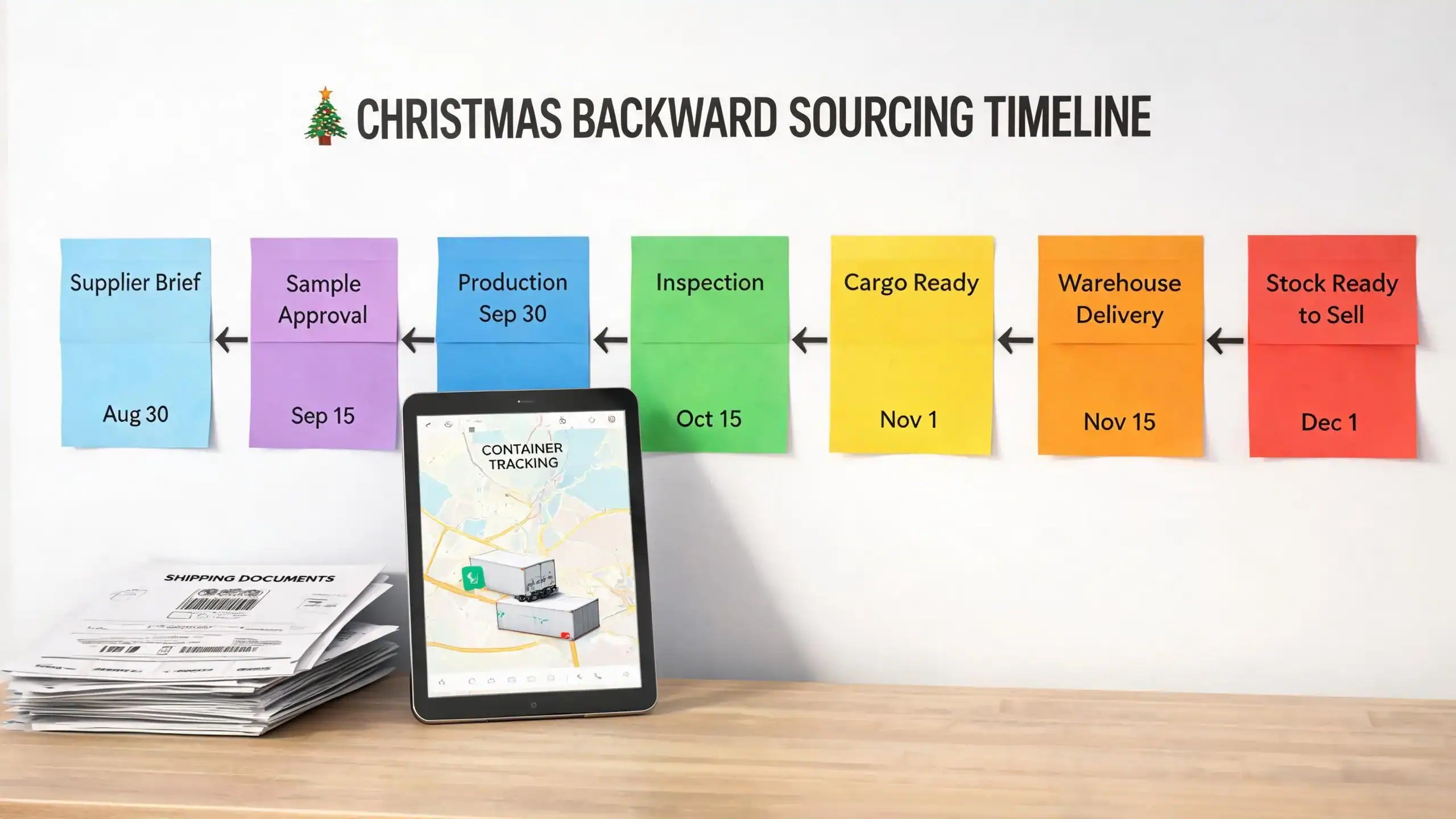
Do not simply add every activity together. Some work can run in parallel: the buyer can clarify receiving requirements while a supplier reviews the design. Other work cannot safely be treated as complete early, such as releasing a revised component that the buyer has not approved. The sequence of dependent activities determines the earliest credible finish.
Where an order draws on several suppliers, the cargo ready date depends on the last delivery into the warehouse, not the first. Warehouse receiving and consolidation then becomes a checkpoint with its own date rather than a step tacked on at the end.
Ocean transit is planned, not guaranteed. Carrier schedule reliability and the average delay for late vessel arrivals are published monthly by Sea-Intelligence. Current figures for your trade lane are a better basis for contingency than a single quoted transit time.
Check the constraints you do not control
Two constraints sit outside your order. Chinese New Year stops most factories for a period each year, and seasonal decoration lines are booked ahead of the shipping window, so a late confirmation competes for capacity against buyers who confirmed earlier.
The statutory holiday dates are set by China’s State Council and announced ahead of each year. Confirm them against your own production window rather than assuming last year’s calendar.
Both constraints are set out in more detail in Minden Intl’s guide to developing custom Christmas decorations with Chinese suppliers. Check where they fall against your own dates before you treat a valid quotation as a secured production slot.

Separate development time from production time
A supplier’s production estimate may begin only after sample approval, material confirmation or other agreed order conditions. Ask what starts the clock and what the estimate includes.
For custom Christmas decorations, the work before that starting point can include checking whether a reference design is buildable, locating accessories, making a sample, sending it for review and correcting differences. Packaging development may add another dependency.
A broad overview of product development in China helps distinguish these stages. For your actual schedule, keep sampling and production as separate lines rather than hiding both inside one factory lead time.
Ask four direct questions before accepting a proposed completion date:
- Which design, sample and quantity does this estimate cover?
- Which materials or accessories are confirmed, and which are still provisional?
- What buyer decisions must be made before work can start?
- What changes would require a new schedule?
Allow for buyer approval, not just factory work
Approval consumes calendar in the same way production does, and it is the one section of the schedule the buyer controls entirely.
Decide the review method before the sample is made. Some appearance questions can be settled from clear photos and video. Size, feel, stability or packaging performance may need a physical sample, which adds courier transit in both directions plus the buyer’s own review time. Ask your courier for actual transit days to your address rather than assuming them.
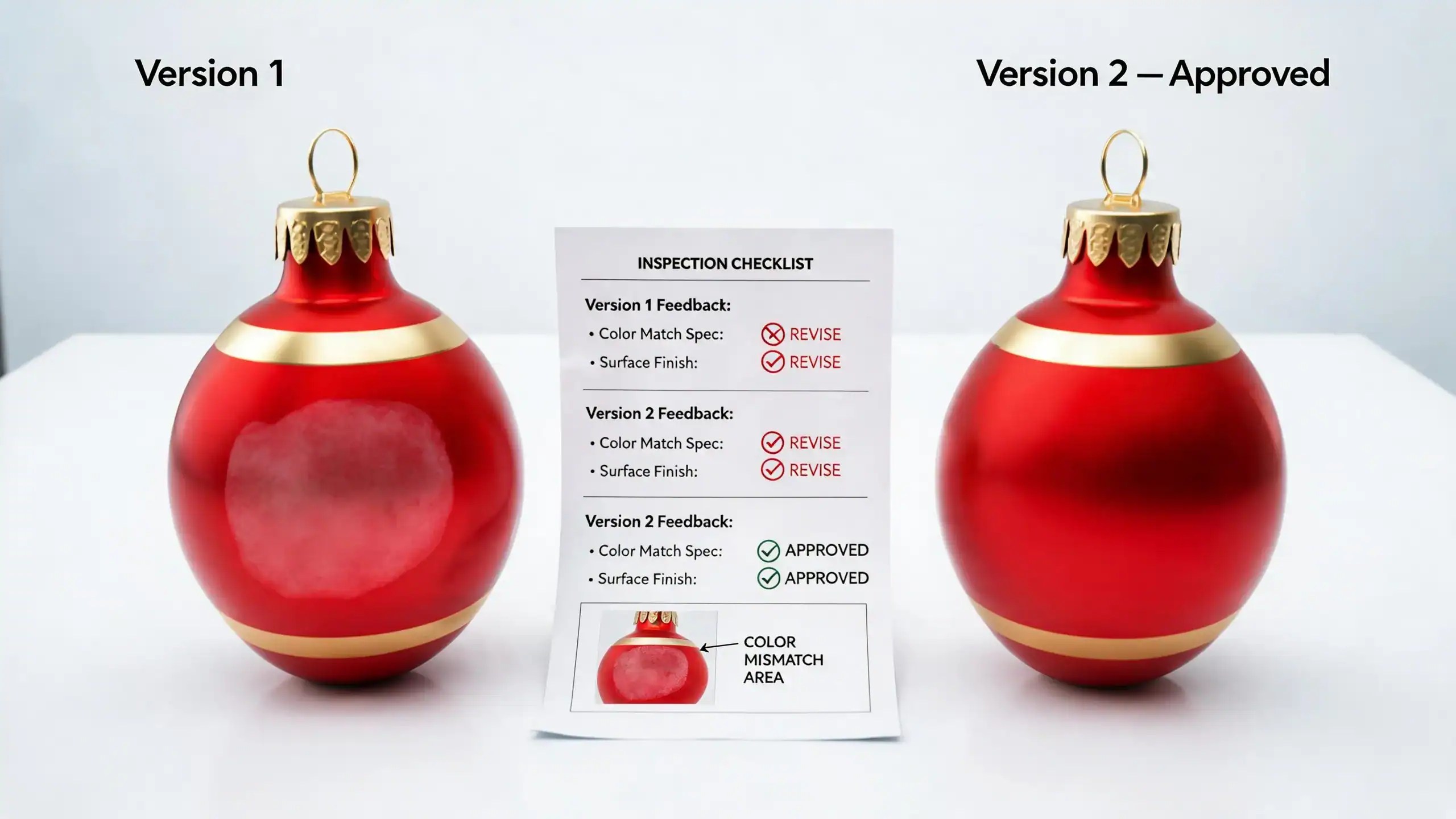
Then name the person who gives the final decision and the date by which they will give it. If each round takes five working days to review, two rounds is two working weeks that no supplier can compress on your behalf.
How to log versions, consolidate feedback and define the approved production reference is covered separately in sample management in China sourcing. For the timeline, what matters is that every review round has a date attached to it and an owner who has accepted that date.
What one Minden Intl project shows about seasonal timing
In a custom Christmas decoration sourcing project for a US wholesaler, three factories were shortlisted and the design went through two rounds of sample revision before reaching an accepted visual match. That part of the work was planned for.
What was not planned came later. An accessory component was unavailable when production ran, which left one style with a color deviation. The deviation was found at inspection, the factory carried out a color adjustment and an accessory swap, and a second review round was completed before the goods were released.
The timing lesson is in the sequence. The correction happened after production, against a fixed selling season, and it was only workable because calendar remained. Sample approval reduces uncertainty; it does not remove material substitutions or production issues. A schedule with no space after the production checkpoint has no way to absorb one.
Build decision points into the plan, not just deadlines
At each review, compare the remaining work with the warehouse deadline. When a dependency moves, update the downstream dates and state what decision that creates for the buyer.
Useful decision points include:
- Design decision: keep developing the custom item, simplify an approved feature, or consider an existing design.
- Assortment decision: retain all styles or remove an item that holds up the rest of the order.
- Shipment decision: assess whether a partial shipment is commercially worthwhile and operationally feasible.
- Season decision: proceed for the intended selling window or prepare the item for a later season.
These are options to assess, not automatic remedies. A faster transport mode does not fix an unapproved sample, unavailable material or goods that have failed the agreed checks. Changes in cost, specification or commercial terms need the buyer’s approval.
Where you hold contingency time, attach it to the risk it covers: a pending component, a likely sample revision, or a correction round after production. A buffer with a named reason can be defended or released on evidence. A single unexplained buffer usually hides a date nobody has confirmed.
What to send before asking whether an order can arrive in time
Send the product references, quantity by style, destination country and warehouse deadline, plus the current sample status. Identify the features that cannot change and any flexibility in quantity, assortment or arrival date.
Minden Intl can review the sourcing and development requirements with you and identify which schedule inputs still need supplier or logistics confirmation. Send your Christmas product list and required warehouse date so the discussion starts with the actual order conditions.
Frequently asked questions
Why will a supplier not give me one lead time for the whole order?
Because a supplier controls only part of it. A production estimate usually begins after sample approval and material confirmation, and ends at cargo ready. Development before that point, and transport, destination handling and receiving after it, are confirmed by other parties. Ask each party for the section they actually control.
Can I place a custom order in September for the same Christmas season?
Do not assume it is feasible. The answer depends on the state of the design and samples, material availability, factory capacity, destination and remaining delivery window. Get those inputs checked before committing to the season or promising a launch date.
Does an approved sample secure the production slot?
No. Approval settles what will be made, not when a factory will make it. Confirm material availability, order conditions and capacity separately, and reconfirm them if the order start date moves.
What is the difference between the cargo ready date and the warehouse delivery date?
Cargo ready means accepted goods, packing and documents are complete and the shipment can be booked. Warehouse delivery adds transport, destination handling and a receiving appointment. Planning against the first date while reporting it as the second is a common way for a seasonal plan to slip before anyone notices.
Should repeat orders use the previous year’s schedule?
Use it as a reference, then reconfirm quantities, components, packaging, capacity and delivery requirements. A familiar product can still have a different supply situation.
Planning a seasonal order against a fixed delivery date?
Minden Intl can coordinate supplier confirmation, sample rounds, production follow-up, inspection and shipment preparation in China, and show you which dates in your plan are still unconfirmed.