This China sourcing problems report reviews 24 published Minden Intl projects that reached a bulk order or shipment. In 20 of them, the main issue was found before goods left China.
The report records where problems appeared and how they were handled. It is project data from one sourcing company, not an industry survey or defect rate.
Key Findings
- 20 of 24 projects showed their main issue before goods left China.
- 13 of 24 showed it during sourcing or sample approval, before bulk production.
- 6 of 24 centred on availability or supplier capability, the largest group.
- 1 of 24 had its main issue in transit, and 3 of 24 recorded no main issue.
How the Projects Were Selected and Classified
We reviewed all 27 projects listed under our Case Study category on 3 November 2026. We kept the 24 that reached a bulk order or shipment. Three were excluded: one market visit, one certification guide and one project still at sample stage.
Each project received one main issue and one stage, based only on its published case study. Many projects had more than one problem, so these counts show the main issue, not every issue.
Two projects were not reported as shipped on their case pages, and two others were in transit when written. They are included because their main issue stage was already known.
What Went Wrong Most Often
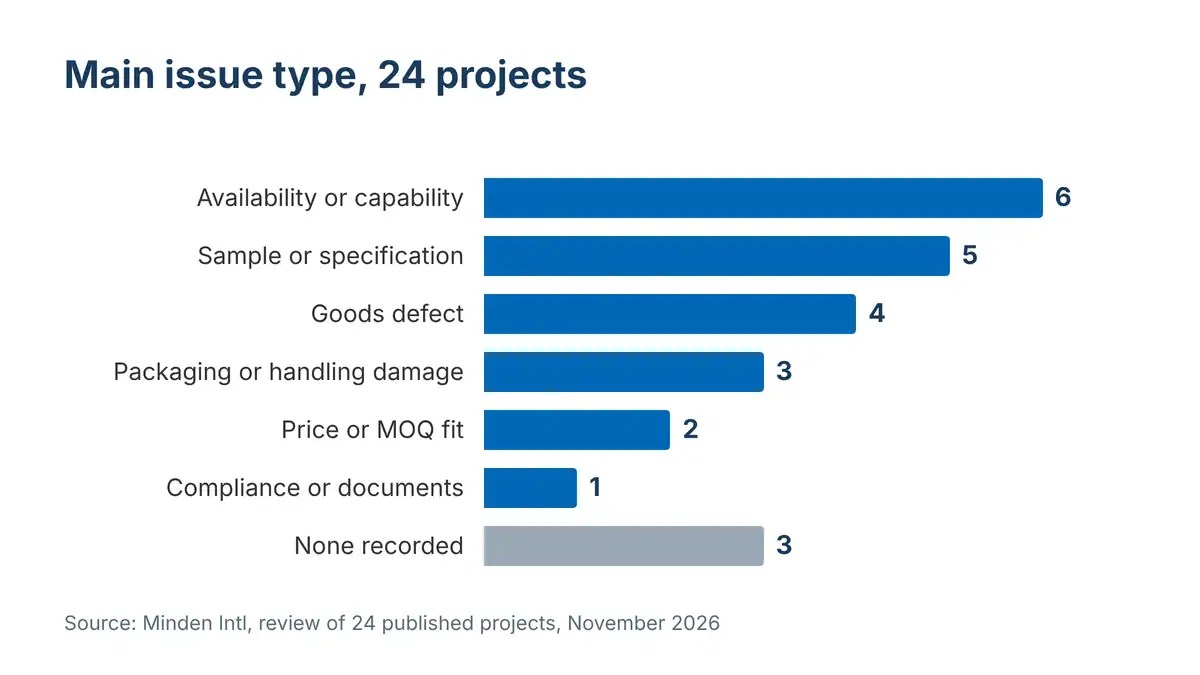
Availability or capability was the largest issue group.
| Main issue type | Projects | Share |
|---|---|---|
| Availability or capability | 6 | 25% |
| Sample or specification | 5 | 21% |
| Goods defect | 4 | 17% |
| Packaging or handling damage | 3 | 12% |
| Price or MOQ fit | 2 | 8% |
| Compliance or documents | 1 | 4% |
| None recorded | 3 | 12% |
Availability problems were not limited to stock orders. They included catalogue items that were not in stock, discontinued styles, missing accessories and factories without the required mold.
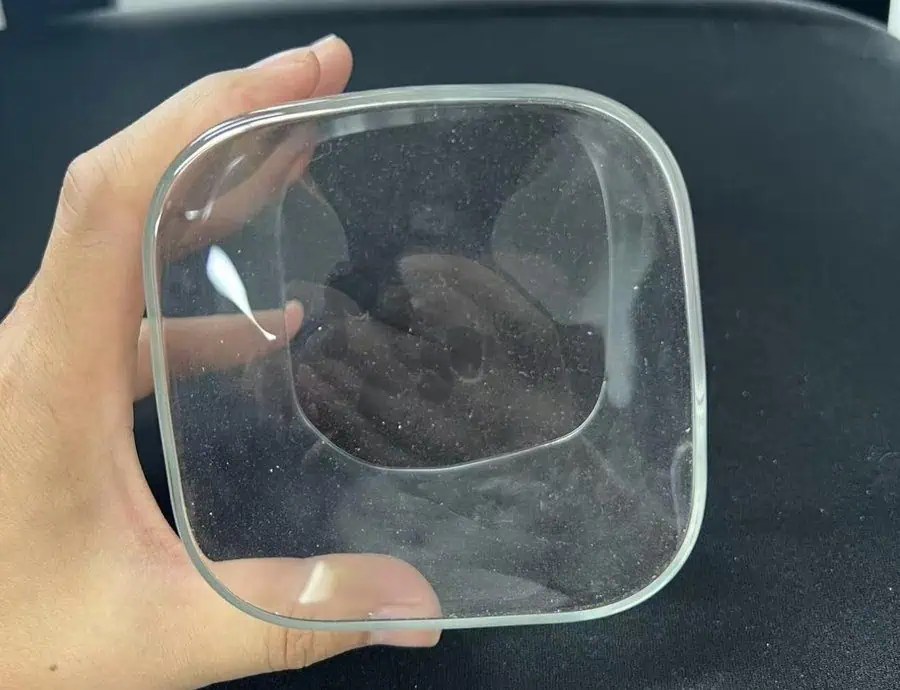
This first sample did not match the buyer reference.
Where Problems First Appeared
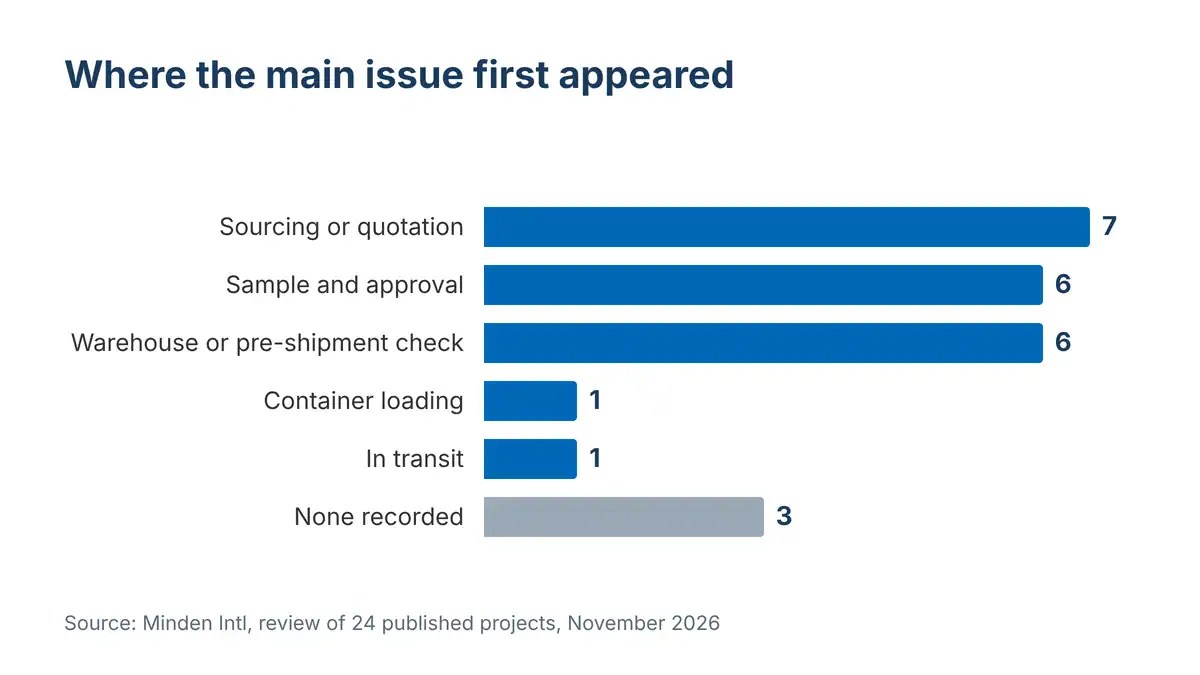
Most main issues appeared before goods left China.
| Where the main issue first appeared | Projects | Share |
|---|---|---|
| Sourcing or quotation | 7 | 29% |
| Sample and approval | 6 | 25% |
| Warehouse or pre-shipment check | 6 | 25% |
| Container loading | 1 | 4% |
| In transit | 1 | 4% |
| None recorded | 3 | 12% |
Sourcing and sample approval accounted for 13 projects. These checks came before bulk production, when changing the supplier, design or product plan was still possible.
Six more issues appeared during warehouse or pre-shipment checks. One appeared during container loading, and one in transit.

Cartons from several suppliers waiting for receiving checks at our warehouse.
What These China Sourcing Problems Show
This sample cannot show how often sourcing fails. It does show which control points kept repeating across products, order sizes and buyer markets.
- Confirm stock on the day you order: a listing or catalogue page does not prove current availability.
- Find the hardest requirement first: filter suppliers on the mold, certificate or feature that is hardest to supply.
- Approve one sample version: keep it as the production reference. This sample management guide shows the record to keep.
- Agree the inspection plan early: set the stage, sampling method and defect definitions before production ends. ISO 2859-1 is the usual reference for AQL sampling.
- Check goods at receiving: count and open cartons before loading, especially on orders consolidated from several suppliers.
- Check import requirements before ordering: UK importers should confirm whether they need an EORI number. New US importers can start with CBP’s tips for new importers.
- Agree who carries the risk: confirm responsibility under the relevant Incoterms rule before goods move.
Project Data Table
Client names and prices are excluded from this table. Each row links to the published case study used as its source.
| # | Market | Product | Main issue | Type | Stage | Response | Source |
|---|---|---|---|---|---|---|---|
| 1 | US | Stock toys | One carton crushed on the third order | Packaging or handling damage | In transit | Value refunded; stronger cartons used on later orders | Case |
| 2 | US | Packaging and sealing machine | Machine fell over during inland transport | Packaging or handling damage | Warehouse or pre-shipment check | Repaired locally and retested at US voltage | Case |
| 3 | US | Stock winter hats | Stock batch had loose threads and lint | Goods defect | Sample and approval | Buyer told before ordering; hats reworked by hand | Case |
| 4 | Canada | Custom cutting boards | Most factories lacked the required edge mold | Availability or capability | Sourcing or quotation | Search limited to factories with the mold | Case |
| 5 | Ecuador | Private label tops | Woven neck label edges were too hard | Sample or specification | Sample and approval | Fourth label factory solved it; net delay 5 days | Case |
| 6 | Ecuador | Fabric | No issue recorded after swatch matching | None recorded | None recorded | Repeat orders placed | Case |
| 7 | US | Custom printed bags | 150 print designs pushed the order far above test volume | Price or MOQ fit | Sourcing or quotation | Designs moved behind one QR code | Case |
| 8 | Mexico | Machinery and disposables | No major issue recorded | None recorded | None recorded | Coordinated into two high-cube containers | Case |
| 9 | Mexico | Gift packaging | Catalogue styles were not physical stock | Availability or capability | Sourcing or quotation | Order split between market stock and factory runs | Case |
| 10 | Singapore | New electric product | First sample missed speed and function needs | Sample or specification | Sample and approval | Redeveloped through repeated testing | Case |
| 11 | UK | Custom sportswear | First pattern sample was unusable and colour missed | Sample or specification | Sample and approval | Supplier and print method changed | Case |
| 12 | US | Exhibition furniture | One-piece bar cracked at the leg joint | Goods defect | Container loading | Compensated, then redesigned as modular | Case |
| 13 | US | Stock toys | Selected colour mix was out of stock | Availability or capability | Sourcing or quotation | Buyer approved a replacement | Case |
| 14 | US | Custom boat | Inspection found uneven paint and exposed wiring | Goods defect | Warehouse or pre-shipment check | Reworked and rechecked before loading | Case |
| 15 | Canada | Venue furniture | Some target prices were below production cost | Price or MOQ fit | Sourcing or quotation | Cost breakdown shared before moving forward | Case |
| 16 | US | Mixed memorial sets | Cracked boards and bubbling panels at receipt | Goods defect | Warehouse or pre-shipment check | Counted and replenished by the factory | Case |
| 17 | UK | Pet products | Target products carried copyright risk; EORI missing | Compliance or documents | Sourcing or quotation | Similar products chosen; delivery route changed | Case |
| 18 | UK | Mixed stock designs | No specific issue recorded | None recorded | None recorded | Three suppliers coordinated | Case |
| 19 | US | Glassware | First samples did not match the reference | Sample or specification | Sample and approval | Supplier switched before bulk order | Case |
| 20 | US | Whole-house furniture | Sofa needed several revision rounds | Sample or specification | Sample and approval | Each stage approved before production moved on | Case |
| 21 | Paraguay | Multi-category goods | Some requested styles were discontinued | Availability or capability | Sourcing or quotation | Current alternatives proposed | Case |
| 22 | US | Seasonal decor | Accessory substitute shifted the colour balance | Availability or capability | Warehouse or pre-shipment check | Affected style reworked and reapproved | Case |
| 23 | US | Mixed retail goods | Goods arrived short on three SKUs | Availability or capability | Warehouse or pre-shipment check | Replacement stock and quantity adjustment agreed | Case |
| 24 | Paraguay | Mixed hardware | Outer cartons damaged on inbound shipments | Packaging or handling damage | Warehouse or pre-shipment check | Patched or replaced before loading | Case |
Limits of This Data
- All projects come from one sourcing company.
- Published cases are selected, and projects with a clear problem are more likely to be written up.
- Classification was done by Minden Intl, using its own published cases.
- “None recorded” means the case study names no main issue, not that nothing went wrong.
If you cite this page, please describe it as “a review of 24 published Minden Intl projects”, not as an industry survey.
FAQ
What are the most common China sourcing problems in this report?
Availability or supplier capability was the largest group, with 6 of 24 projects. Sample or specification problems came next, with 5 projects.
Does this report show a sourcing failure rate?
No. The projects were selected for publication, so the figures cannot be used as a failure rate or industry benchmark.
Why does each project have only one main issue?
One main issue keeps the classification consistent. Several projects had other problems, which are described in their case studies.
Planning an Order from China?
Send your product details, target market and estimated quantity. Minden Intl will review them and explain what should be confirmed before you place an order.