
Amazon FBA prep & inbound compliance 2026 starts with one fact: Amazon no longer fixes your mistakes. Since January 1, 2026, Amazon has stopped offering prep and item labeling for FBA shipments in the US store. Units that arrive unlabeled, unbagged or badly packed are now the seller’s problem, and the seller’s cost.
For buyers sourcing from China, that changes where the work happens. Labels, polybags, carton marks and box weights now have to be right before the container leaves the factory. Fixing them in a US prep center after a 30-day ocean voyage is possible. It is also the most expensive place to do it.
This guide covers what changed in 2026, what Amazon’s inbound requirements actually check, and how we get goods FBA-ready at origin.
What Changed for FBA Sellers in 2026
Three changes landed within three months of each other.
January 1: prep and labeling services ended. The change covers every route into US FBA, including Amazon Warehousing and Distribution (AWD), Amazon Global Logistics, Amazon Send and Supply Chain Portal. Shipments created after that date that arrive without proper prep or labeling are not eligible for reimbursement if units are damaged or lost.
January 15: new fee schedule. Average fulfillment fees rose by about $0.08 per unit. Inbound defect fees for abandoned, late or wrong-location shipments were merged into a single fee, averaging around $0.60 per unit, and published rates now run from roughly $0.32 to $5.72 per unit for standard-size items depending on size and weight. The exact numbers are on Amazon’s inbound defect fee page.
March 31: commingling ended. Stickerless, commingled inventory is gone. Resellers must put an FNSKU on every unit. Brand owners in Brand Registry can still ship on their manufacturer barcode (UPC or EAN).
None of these rules is new in itself. What’s new is that the safety net is gone at the same moment the penalties went up.

FNSKU in 2026: Who Needs One and Where It Goes
The FNSKU is Amazon’s own barcode. It starts with X00 and ties each unit to your seller account, not just to the product. Two sellers selling the same item carry two different FNSKUs.
The decision is simple. If you are the brand owner with Brand Registry and a valid GS1 barcode printed on the packaging, you can choose manufacturer barcode tracking. If you are a reseller, or you want your units kept separate from everyone else’s, you label with FNSKU.
When FNSKU is used, the label must cover the manufacturer barcode completely. A box with two scannable barcodes is a box Amazon’s receiving team can scan wrong. Print labels from Seller Central, keep them flat and readable, and never place them across a seam or a curve.
Missing labels are rarely the real problem. Swapped labels are. A factory packing six color variants of one product will see six X00 codes that look almost identical. If the labels sit in one pile on the packing table, variants get crossed. We had a similar issue on a wooden urn set that went through three label revisions before the artwork and the physical product finally matched.
The fix is boring and it works. One SKU per packing station. One label roll per station. A scan test on random units before the carton is sealed.
Polybag Labeling and Packaging Rules That Trip Up Chinese Factories
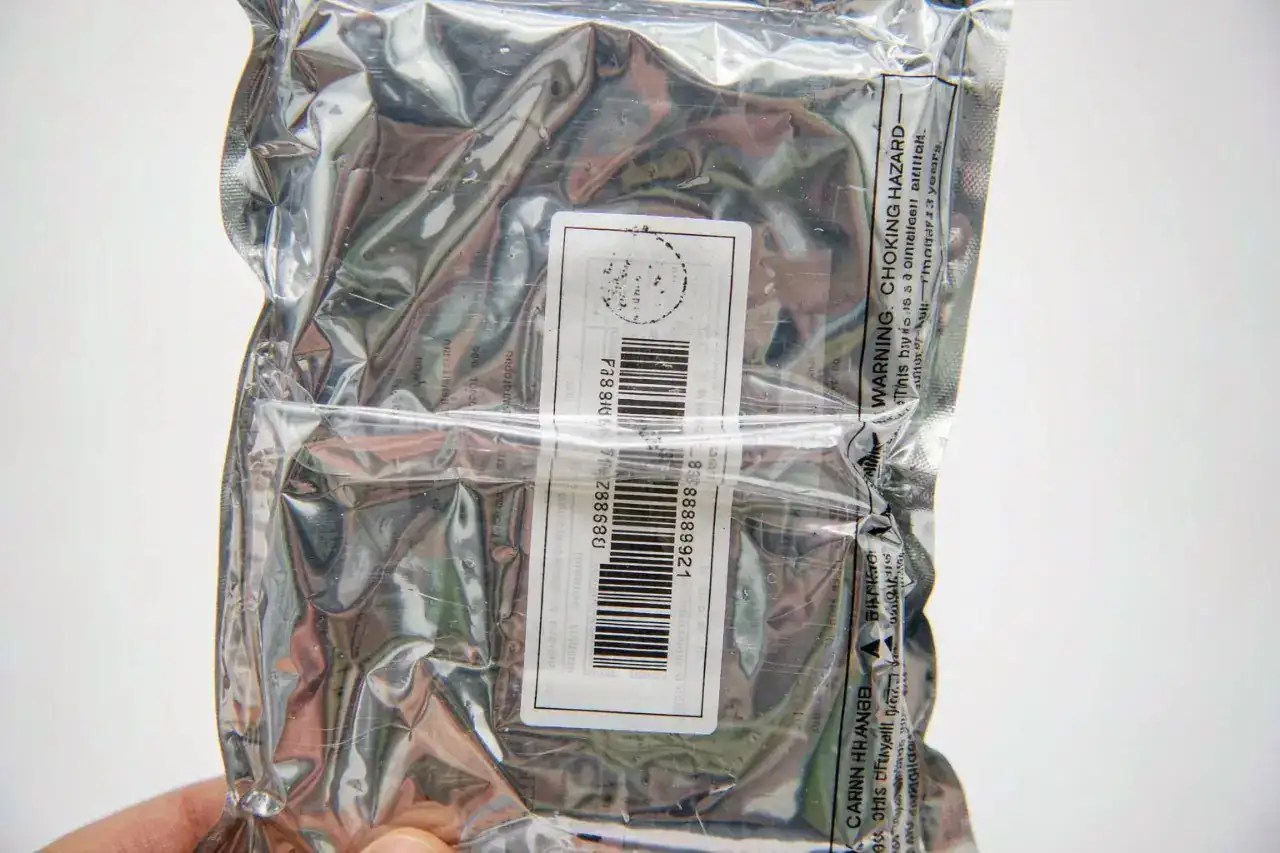
Polybags are where most factory-side compliance problems start, because the factory’s default bag is rarely Amazon’s bag. Amazon’s packaging and prep requirements set out the rules:
- Bag thickness of at least 1.5 mil
- Transparent bag, fully sealed
- A suffocation warning on any bag with an opening of 5 inches or more, printed or labeled
- A barcode that scans through the bag, or an FNSKU label on the outside
- No more than 3 inches of bag beyond the product
What most buyers don’t realize is that Chinese bag suppliers don’t quote in mils. They quote in si (丝), where 1 si is 0.01 mm, and they often quote the total of both layers. 1.5 mil is about 0.038 mm per layer. So a bag sold as “4 si double-sided” is roughly half the thickness Amazon requires. Ask for at least 4 si per layer, and get it written on the purchase order.
The suffocation warning is the other common miss. Pre-printed English warning bags are easy to buy in Yiwu, but some factories use bags with the warning in Chinese only, or in type too small to read. Check the actual bag, not the supplier’s photo. Our product packaging team confirms bag specs before production, because changing bags after 5,000 units are packed means unpacking 5,000 units.
Sets and bundles need one more step. Each set must be packed so it can’t be split, and marked “Sold as set” or “Do not separate.” Without that, Amazon can receive one bundle as several single units.Our product bundling service packs and labels sets in China before they ship.
Dimensional Weight: The Cost You Lock In at the Sample Stage
For Large Standard and bulky size tiers, Amazon charges fulfillment fees on whichever is greater, unit weight or dimensional weight. Dimensional weight is length × width × height in inches, divided by 139.
Here is how fast that adds up. A 2 lb product in a 14 × 10 × 6 inch box has a dimensional weight of about 6.0 lb. Amazon bills it as a 6 lb item. Bring the box down to 12 × 9 × 5 inches and the dimensional weight drops to about 3.9 lb. Same product, same factory, lower fee on every unit sold.
This happens a lot with gift sets, kitchenware and anything sold in a printed color box. The box gets designed for shelf presence, then sold on a platform that charges by volume.
The time to fix it is before the color box is printed. Once 3,000 printed boxes exist, the dimensional weight is locked for the whole run. We ask factories to measure the finished retail pack, not the product, and compare it against the dimensions in Seller Central before mass production. Amazon also measures units at receiving. If its numbers come back larger than yours, the fee changes without warning.
Inbound Requirements for Cartons Shipped From China
Unit prep gets most of the attention. Cartons cause just as many problems. Amazon’s shipping and routing requirements cover the core inbound requirements:
- Standard FBA cartons up to 36 inches long and 25 inches on the other sides (the length limit rose from 25 inches in June 2025)
- AWD cartons still limited to 25 × 25 × 25 inches
- 50 lb maximum per carton, unless it holds a single item heavier than that
- An FBA box ID label on every carton, plus the carrier label
- Box content information for each carton, through 2D barcode or Seller Central
The AWD limit catches people out. A carton built for FBA can be refused at an AWD facility. Confirm the destination before the factory cuts carton boards.
Weights and dimensions are the other weak point. Factories often quote carton size from the flat board, before packing. A carton packed tight bulges, and a 24.8-inch carton becomes 25.3 inches. We weigh and measure packed cartons, not empty ones, before shipping labels are printed.
Mixed-SKU cartons are allowed, but every carton needs accurate box content. When several factories ship to one order, we bring the goods into our consolidation warehouse first, check counts against the shipment plan, and pack cartons to match what was declared in Seller Central.

Amazon FBA Prep & Inbound Compliance 2026: Prep in China or in the US?
With Amazon out of prep, sellers have three options: prep in-house, use a US or EU third-party FBA prep service, or have it done at origin.
A US prep center makes sense when you are receiving mixed goods from many sources, or when you need flexible storage before replenishing Amazon. It adds a receiving fee, a per-unit fee and an extra trucking leg.
Prep at origin makes sense when one order comes from a small number of factories and ships direct to Amazon. Labor in China is cheaper, and errors get fixed on the packing line instead of in a US warehouse. The tradeoff is control. Someone has to be physically there to check labels, bags and cartons before loading. A factory will not flag a label problem on its own.
For a first-time UK Amazon FBA seller sourcing pet products, the choice came down to the same question every seller faces: who checks the goods before they leave China?
A Pre-Shipment FBA Compliance Checklist
| Check | What to confirm | When |
|---|---|---|
| Barcode choice | FNSKU or manufacturer barcode, set in Seller Central | Before artwork |
| Retail pack dimensions | Measured finished pack vs Seller Central listing | Sample approval |
| Polybag | 1.5 mil per layer, transparent, English suffocation warning | Before mass production |
| FNSKU labels | Correct variant, covers UPC, scans cleanly | During packing |
| Sets and bundles | Secured, marked “Sold as set” | During packing |
| Cartons | Within size limits for FBA or AWD, 50 lb max | Before carton order |
| Carton labels | FBA box ID on each carton, box content submitted | Before loading |
| Final inspection | Random label scan test, count check, carton weights | Before loading |
What 2026 Means for Sellers Sourcing From China
FBA compliance used to be something sellers could leave half-done, because Amazon would finish it for a small fee. That option is gone. The cost of a labeling error is no longer a few cents per unit. It can be a refused shipment, an unreimbursable loss, or a fee that wipes out the margin on a whole replenishment.
The sellers who handle Amazon FBA prep & inbound compliance 2026 best treat Amazon’s requirements as part of the product spec, not a logistics step. The bag thickness, the label position and the carton size go into the purchase order with the color and the material. Most factories will follow a written spec. Very few will follow one that was only discussed on WeChat.
One thing we see from the China side: compliance problems rarely come from the factory not caring. They come from the factory not knowing. A factory that ships to Walmart, a German wholesaler and an Amazon seller in the same week has three different packing standards to remember. Write yours down.
FAQ
Does Amazon still offer FBA prep service in 2026?
No. Amazon ended prep and item labeling for US FBA shipments on January 1, 2026. Sellers now prep goods themselves, use a third-party FBA prep service, or have it done by the supplier or sourcing agent before shipping.
Do I need FNSKU labels in 2026 if I own the brand?
Not always. Brand owners in Brand Registry can track inventory by manufacturer barcode if a valid UPC or EAN is printed on the packaging. Resellers must use FNSKU labels since commingling ended on March 31, 2026.
What are Amazon’s polybag labeling requirements?
The bag must be at least 1.5 mil thick, transparent and fully sealed. Bags with a 5-inch opening or larger need a suffocation warning. The barcode must scan through the bag, or an FNSKU label must go on the outside.
Can a Chinese factory apply FNSKU labels before shipping?
Yes, and for direct-to-Amazon shipments it is usually the cheapest place to do it. The risk is swapped variant labels, so someone should run a scan check on random units before cartons are sealed.
What are the inbound requirements for cartons sent to FBA?
Standard FBA cartons can be up to 36 inches long and 25 inches on other sides, with a 50 lb limit. AWD cartons are limited to 25 inches on every side. Each carton needs an FBA box ID label and accurate box content information.
Sourcing for Amazon FBA From China?
Minden Intl checks labels, polybags and cartons at our Yiwu and Guangzhou offices before goods leave China. Send us your product and shipment plan, and we’ll tell you what needs fixing before it ships.


