A hat wholesaler in the United States came to us for wholesale winter hats: 3,010 fleece-lined knit hats for men and women, needed by 10 September for the winter selling season. The order was price-sensitive, which led to stock products rather than custom production. Stock products came with a quality limit the client did not expect: loose threads and lint the factory could not fully remove.
This case study shows how that limit surfaced at the sample stage, what we did when it showed up again in the bulk goods, and what buyers should ask before ordering stock products from China.
Order
3,010 knit hats
Suppliers
2 (men’s and women’s)
Damaged hats replaced
21
The Client: A US Hat Wholesaler Buying Wholesale Winter Hats
We first met the client at a trade show in the United States in 2024. In 2026, he contacted us with a concrete order: fleece-lined knit hats for men and women, a total of 3,010 pieces, with the goods needed by 10 September.
Two things shaped the project from the start:
- Price. The client was highly price-sensitive, so stock products from existing factory inventory made more sense than custom production.
- Timing. Winter hats are seasonal. We advised him to order early, so that production, consolidation and shipping would fit comfortably before the deadline.
We sourced the men’s and women’s hats from two different suppliers, each specializing in its category. For an order of knit beanies wholesale at this price level, the priorities were price and on-time delivery rather than a custom design.
The Sample: Loose Threads and Lint
When the men’s sample arrived, it had untrimmed threads and visible lint. We raised this with the factory, and its explanation was straightforward:
- The hats were stock products, already made.
- The factory’s equipment could not fully remove the loose threads and lint from this style.
- At this price, it could not rework the whole batch. It could only do light handling when attaching labels.
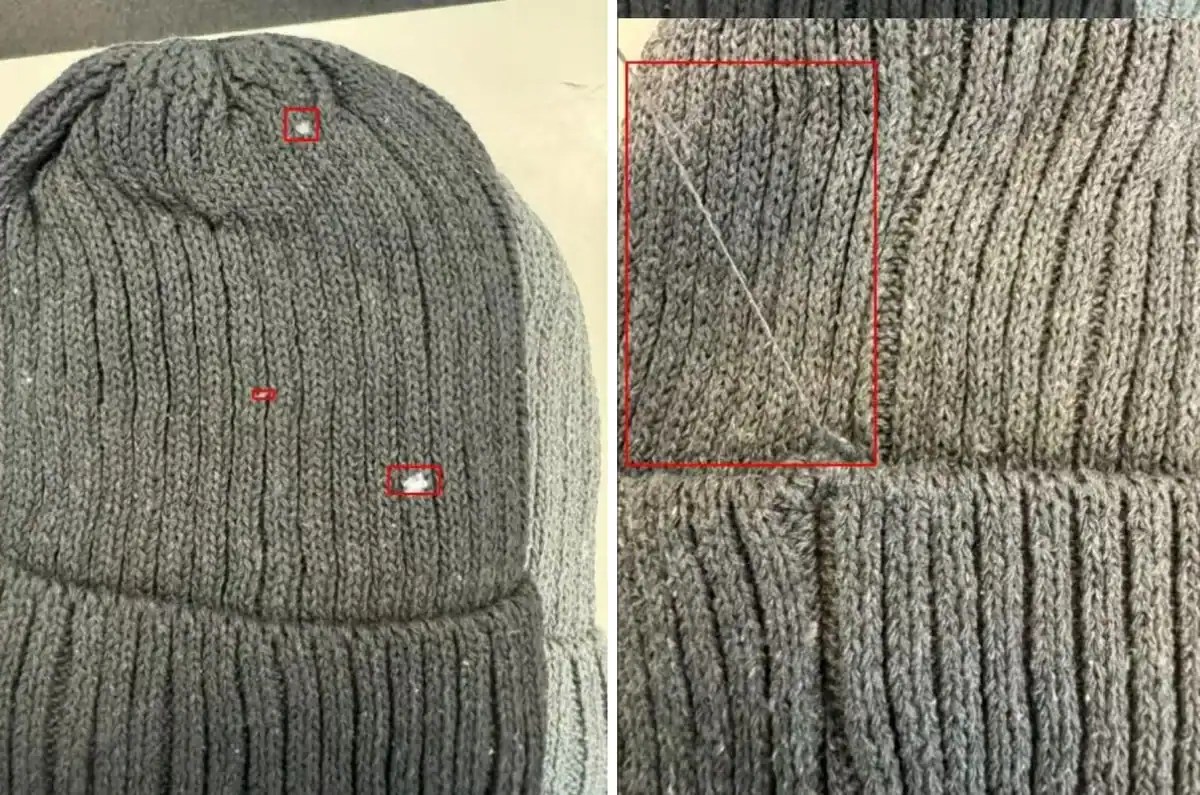
We passed this on to the client in full, before he ordered: the problem, the cause and what the factory could and could not do. With that information, he chose to order 1,075 men’s hats from this supplier.
Bulk Goods: The Same Problem, Handled at Our Warehouse
When the men’s hats reached our warehouse, the loose threads and lint were still there, as the factory had warned. Returning the goods would have cost time the client did not have before his 10 September deadline.
Instead, our warehouse team reworked the hats by hand: trimming loose threads and removing lint. During that check, we found 21 damaged hats, with holes and tears in the knit or the fleece lining. We reported them to the supplier, which replaced them. Once the rework was complete and the replacements arrived, everything was consolidated into one shipment through our shipment consolidation service. At the time of writing, the goods are in transit.


Stock Products vs Custom Production: Where Quality Stops
| Decision | Existing stock | Custom production |
|---|---|---|
| Product reference | Confirm the actual batch available and its condition | Agree the specification and the reference for production |
| Quantity | Confirm available quantities by style and color | Obtain MOQ for the product, material, color and customization |
| Timing | Include stock confirmation, checks, any rework and shipping | Include sampling, approvals, production, checks and shipping |
| Finishing limits | Ask what can be corrected on the existing batch | Agree required finishing and how it will be checked |
| Additional work | Confirm whether the supplier or another party can perform it, at what cost | Include the required work in the agreed production scope |
| Acceptance | Decide whether the observed condition is acceptable | Check the goods against the agreed requirements; customization does not guarantee the result |
In this project, the sample made a finishing limitation visible before the order. The useful buyer decision is whether to accept the condition, agree a feasible correction or choose a different supply option. Stock does not automatically mean immediate delivery, and custom production does not remove the need for inspection.
What to Ask Before Buying Stock Products from China
- Is the sample from the same batch as the bulk goods? If not, ask for photos from the actual stock.
- What can the factory fix, and what can it not? Get the answer before ordering, as this client did.
- Who will rework, and at what cost? If the factory will not, decide whether reworking at a warehouse is acceptable.
- Are the labels right? Stock hats often need your own labels. In the US, textile products need fiber content, country of origin and manufacturer identity on the label; see the FTC textile labeling guide.
- If the limit is unacceptable, switch early. A factory with better finishing equipment may cost more, but it costs less than rework after the goods arrive.
Record the decision before releasing the order
Keep the batch reference and sample findings with the order. State which issues are accepted, which need correction, who will do that work and what evidence is needed before shipment. Obtain the cost and schedule implications before authorizing rework.
If the required correction cannot be achieved, compare another stock option with a custom order against the same essential requirements. Do not place the order on the assumption that a warehouse will solve an unresolved product problem later.
For the approval record, see sample management in China sourcing.
Buying seasonal stock products from China?
Send your product references, quantity by style, destination and required arrival date. Include any sample findings and the conditions you cannot accept. We can review available sourcing options and clarify whether inspection, rework, labelling or consolidation should be included in the agreed project scope.